
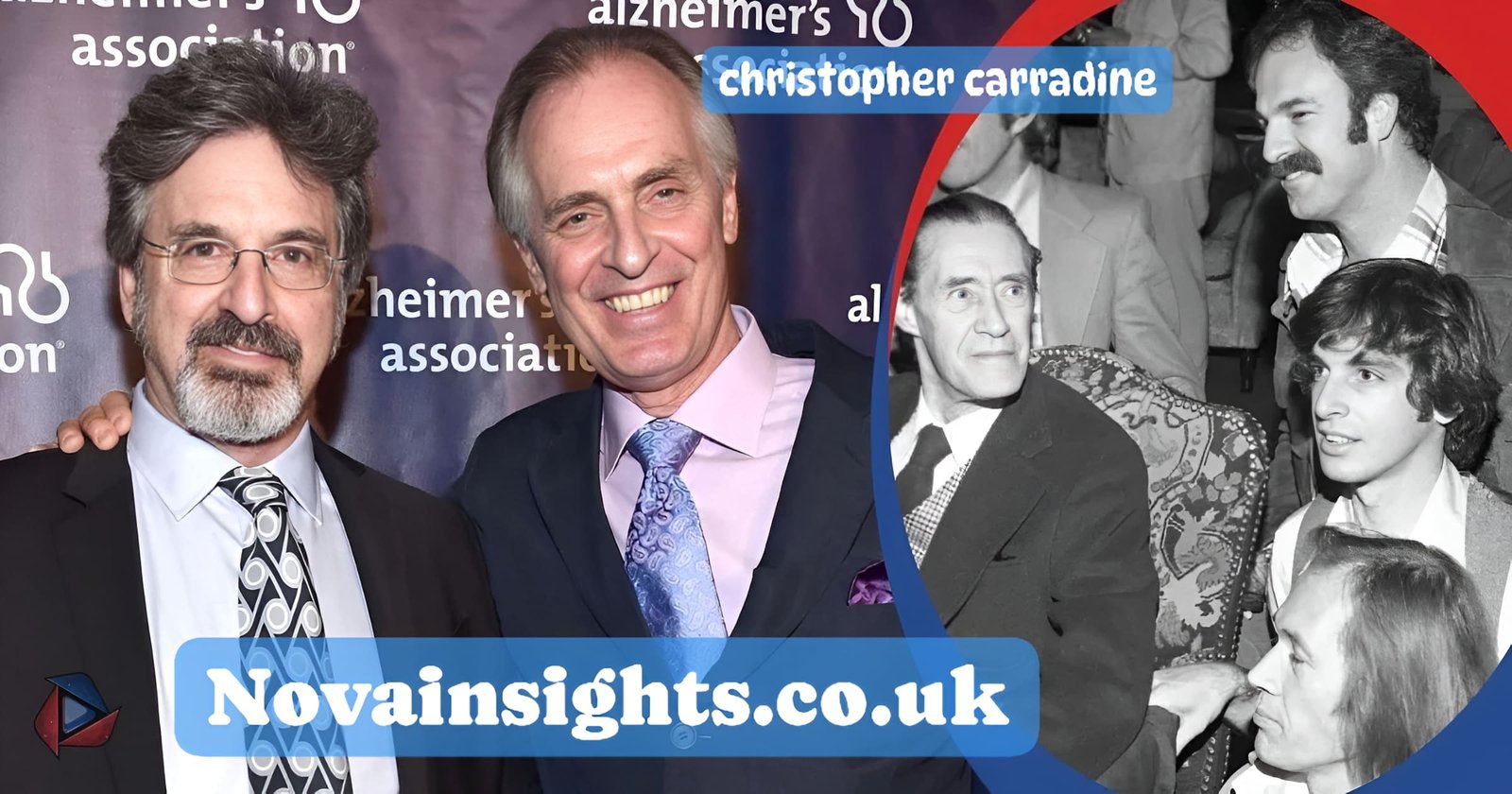
Christopher Carradine is an American architect and former Vice President of Walt Disney Imagineering, born on January 23, 1947, in New York City. Unlike his famous siblings — David, Keith, and Robert Carradine — he chose architecture over acting. He spent nearly 28 years at Disney, leading landmark projects including Pleasure Island at Walt Disney World, and retired in 2009. He is the son of legendary Hollywood actor John Carradine.
Christopher Carradine is a man who chose blueprints over box office. Born into one of Hollywood’s most iconic families, he defied expectations by building a distinguished career in architecture rather than following his famous brothers into acting. As a senior executive and Vice President of Design Development at Walt Disney Imagineering, he spent close to three decades helping shape the physical and experiential design of Disney parks across the globe. His most notable contribution was leading the creative team that conceived and built Pleasure Island at Walt Disney World — a groundbreaking adult-oriented entertainment district that opened in 1989. Christopher’s story is one of quiet determination, creative brilliance, and a life lived on his own terms, far from Hollywood’s spotlight but very much at the center of creative innovation.
Quick Bio Table
| Full Name | Christopher John Carradine |
| Date of Birth | January 23, 1947 |
| Place of Birth | New York City, New York, USA |
| Age (2026) | 79 years old |
| Father | John Carradine (legendary actor) |
| Mother | Sonia Sorel (actress) |
| Siblings | Keith Carradine, Robert Carradine (full brothers); David Carradine, Bruce Carradine, Michael Bowen (half-siblings) |
| Spouse | Carolyn Carradine (née Martin) – married April 22, 1979 |
| Children | Caitlyn Carradine, Henry Wolfe Carradine (biological); Richard Carradine (stepson) |
| Profession | Architect, Former VP of Walt Disney Imagineering |
| Career at Disney | 1981–2009 (approx. 28 years) |
| Net Worth | Estimated multi-millions (USD) |
| Residence | Malibu, California |
| Nationality | American |
Introducing: Who Is Christopher Carradine?
A Famous Name, A Different Path
Christopher Carradine is a name that carries enormous weight in American cultural history, yet he is perhaps the least publicly recognized member of his legendary family. Born on January 23, 1947, in New York City, Christopher is the eldest son of iconic Hollywood character actor John Carradine and actress Sonia Sorel. While his brothers — David, Keith, and Robert Carradine — went on to build celebrated careers in film and television, Christopher chose a radically different path. He became a licensed architect and spent nearly three decades helping design some of the most beloved entertainment spaces on the planet, including iconic Walt Disney theme parks. His story is as compelling as any Hollywood script, yet it unfolded entirely behind the scenes.
A Family Built on Talent and Turmoil
The Carradine family is one of the most storied acting dynasties in American entertainment history. Their patriarch, John Carradine, appeared in more than 350 films and was celebrated for powerful performances in The Grapes of Wrath, Stagecoach, and countless horror classics. But behind the glamour was a personal life defined by instability. John married four times, and his union with Sonia Sorel — Christopher’s mother — ended in a bitter custody dispute. Court records from the time reveal that Christopher and his brothers Keith and Robert were temporarily placed in a home for abused children during the proceedings. These early experiences of instability, rather than breaking Christopher, seem to have forged in him a quiet resilience that would define his entire career and personal life.
Choosing Architecture Over Applause
Despite being raised in a household saturated with acting talent, Christopher Carradine never pursued a career in front of the camera. His sole screen appearance is in a 1979 unreleased family documentary called The Carradines Together, in which he appears as himself. Instead of auditioning for roles, Christopher enrolled in architectural studies, earned his California architecture license (C-22138), and began building a professional foundation rooted in design, structure, and spatial storytelling. This decision set him apart from virtually every other member of his family — and ultimately led him to one of the most creative jobs in the entertainment industry.
Early Life and Education: Building a Foundation
From New York City to Naval Service
Christopher Carradine’s formative years were marked by geographic movement and personal challenge. Born in New York City, he grew up in California after his parents’ separation. After completing his early schooling, he enlisted in the United States Navy in 1966, serving on active duty for approximately three years and seven months. During his naval service, he was trained in aviation hydraulics and structural mechanics — practical, highly technical disciplines that would later inform his architectural instincts. He was assigned to the VF-92 fighter squadron, which operated F4J aircraft in the Tonkin Gulf. He served during deployments aboard the USS Enterprise and USS America, two of the Navy’s most famous aircraft carriers. This military experience gave him discipline, technical expertise, and a broader worldview.
From Military Service to Drafting Tables
After his honorable discharge from the Navy in 1972, Christopher Carradine methodically pursued his passion for design. He began working in established San Francisco architectural firms, honing his craft on real-world projects including BART stations, military facilities like LeMoore NAS and Mare Island Naval Reserve Force, and civil engineering headquarters. He also worked on modular housing for export — a project that demonstrated his early interest in scalable, functional design. These were not glamorous commissions, but they gave Christopher the hands-on experience that no classroom alone could provide. He was learning the language of buildings, the relationship between human behavior and physical space — a skill set that would prove invaluable when he eventually joined the Walt Disney Company.
Marriage, Family, and Personal Stability
In the mid-1970s, Christopher Carradine began building his personal life with the same deliberate care he applied to his professional one. He married Candice Lee Corvi in January 1974, though that marriage ended in divorce in November 1978. On April 22, 1979, he married Carolyn Martin — a union that has endured to this day, making it one of the longest-lasting marriages in a family not especially known for romantic stability. Together they have two biological children: Caitlyn Lace Carradine, born in 1982, and Henry Wolfe Carradine, born in 1990. Christopher also became stepfather to Carolyn’s son Richard Reed Carradine. The couple has resided in Malibu, California for much of their married life, building a home that became deeply meaningful to them before it was tragically destroyed in the 2018 Woolsey Fire.
Walt Disney Imagineering: Where Creativity Meets Architecture
Joining the Magic Factory in 1981
In 1981, Christopher Carradine joined Walt Disney Imagineering — the legendary creative and design division of The Walt Disney Company responsible for the planning, design, and construction of Disney parks and resorts worldwide. His entry into Imagineering was a pivotal moment, marking the beginning of what would become a 28-year career at one of the most creatively demanding organizations in the world. At Imagineering, architects do not simply design buildings; they create entire experiential narratives. Every doorway, every signage detail, every sight line is choreographed to deliver emotional impact. For Christopher, it was the perfect marriage of technical discipline and creative storytelling — a field that drew on everything he had learned in his architectural career so far.
Rising to Vice President of Design Development
Christopher Carradine steadily advanced through Disney’s ranks, holding the position of Vice President of Environmental Design from 1985 to 1989, among other senior roles. He became one of the key figures in the company’s design leadership, working on major theme park projects that have since become global landmarks. His role at Imagineering was not simply managerial; he was deeply hands-on, sketching ideas on cocktail napkins and walking construction sites at all hours. Colleagues and collaborators from that era describe him as a visionary thinker with a fearless approach to design — someone who was not content with the ordinary and who constantly pushed the boundaries of what a designed experience could achieve. He worked in this capacity for close to three full decades before retiring in 2009.
The Philosophy of ‘Narrative Placemaking’
One of Christopher Carradine’s most enduring contributions to the field of entertainment design is his philosophy of what he and his colleagues called ‘narrative placemaking’ — the belief that great spaces should tell stories and invite guests to become active participants rather than passive observers. He was deeply influenced by visionary architects like Jon Jerde, the designer of Horton Plaza in San Diego, whose work demonstrated that architecture could function as urban storytelling. Christopher took this philosophy and applied it systematically to his Disney projects, designing environments that felt organic, layered, and alive. His approach was always to ask: what story does this place tell, and how does it invite the guest into that story? This question guided every major design decision he made during his Disney tenure.
Pleasure Island: Christopher Carradine’s Defining Achievement
Conceptualizing an Entire Entertainment World
The project that most clearly defines Christopher Carradine’s legacy at Disney is Pleasure Island — an adult-oriented nightlife and entertainment district at Walt Disney World Resort in Florida. The concept was announced by Disney CEO Michael Eisner in July 1986, and Christopher was appointed as the lead architect of the project. Working alongside show producer Rick Rothschild, art director Joe Rohde, and writer Craig McNair Wilson, he led a multidisciplinary team charged with creating an entirely new kind of Disney experience — one aimed not at children but at adults, offering themed nightclubs, live entertainment, and interactive environments unlike anything Disney had built before. The project reflected Christopher’s deep belief that entertainment design should engage all the senses and demand active participation from its audience.
Drawing Inspiration from the Real World
Christopher Carradine’s creative process for Pleasure Island was grounded in real-world observation and study. He was particularly inspired by Granville Island in Vancouver, Canada — an urban district where a former industrial and manufacturing area had been thoughtfully transformed into a vibrant cultural hub of restaurants, theaters, galleries, and workshops. Christopher saw in Granville Island a template for what Disney could do with an underutilized waterfront parcel at Walt Disney World. His team also looked at Church Street Station in Orlando, which had become one of the most popular tourist attractions in Florida through its collection of immersive, themed entertainment venues. These real-world references gave Pleasure Island an authenticity and texture that distinguished it from typical theme park environments.
The ‘Theater of Interaction’ Vision
Christopher Carradine described his vision for Pleasure Island as a ‘theater of interaction’ — a phrase that captures the essential philosophy behind the entire project. Rather than designing spaces where guests simply watched performers or walked through static environments, he engineered places where the guests themselves became part of the entertainment. The Adventurers Club, one of Pleasure Island’s most beloved venues, is the clearest expression of this vision. Styled as a 1930s private club for world explorers, the Adventurers Club featured live improvisational performers, animatronic characters, and a rich backstory that rewarded curious guests with layers of narrative discovery. Colleagues recall that Christopher designed the club’s conceptual layout on a series of cocktail napkins during a late-night meeting in New York City — testament to the organic, passionate way he approached design problems.
Life After Disney and Later Years
Retirement and Private Practice
Christopher Carradine retired from Walt Disney Imagineering in 2009, after nearly 28 years of service. Rather than fading into complete retirement, he returned to independent architectural practice — what he humorously described on his LinkedIn profile as ‘a one-man shop after corporate life — same skills but lazier.’ This self-deprecating description belies the continued seriousness with which he approached his craft. In private practice, he leveraged the full depth of his Disney experience to take on specialized design projects, particularly in the Malibu area where he and Carolyn had built their life. For Christopher, architecture was never just a profession; it was a means of expression, a way of making sense of the world through space and form.
Rebuilding After the Woolsey Fire
In November 2018, the devastating Woolsey Fire swept through Malibu, destroying thousands of acres and hundreds of homes — including the Carradine family residence. For Christopher, the loss was particularly acute; the home contained irreplaceable family heirlooms, personal memorabilia, and decades of creative work accumulated over a lifetime. In the aftermath of the fire, he gave interviews discussing the rebuilding process with characteristic forthrightness. Rather than simply restoring what was lost, he approached the rebuilding project as a new design challenge — an opportunity to create a home that reflected both his architectural principles and the lessons learned from decades of designing for resilience and beauty. His experience also led him to assist others in the Malibu community with their own rebuilding efforts.
Legacy and Family Connections
Today, at 79 years of age in 2026, Christopher Carradine remains one of the most quietly remarkable members of an extraordinary family. The deaths of his half-brother David Carradine in 2009 and his brother Robert Carradine in February 2026 have brought renewed public interest in the Carradine family legacy. Christopher occupies a unique place in that legacy — the one sibling who chose creativity over celebrity, who built rather than performed, and who left his mark not on film reels but on the landscapes that millions of people have walked through and loved. His work at Disney Imagineering has touched the lives of guests who will never know his name, which is perhaps exactly how he always preferred it to be.
The Carradine Family: A Hollywood Dynasty
John Carradine: The Patriarch
To fully understand Christopher Carradine, one must understand the towering figure of his father, John Carradine. Born in 1906 in New York City, John Carradine became one of Hollywood’s most prolific and distinctive character actors, accumulating over 350 screen credits across six decades. He appeared in landmark films including John Ford’s The Grapes of Wrath and Stagecoach, and became particularly associated with horror cinema through his recurring role as Dracula. John was also deeply passionate about the theater, running his own traveling Shakespeare company and performing classical roles on stage throughout his career. His powerful, resonant voice and commanding physical presence made him unforgettable on screen, but his personal life — marked by four marriages and complicated family dynamics — cast long shadows over his children’s upbringing.
The Acting Brothers: David, Keith, and Robert
While Christopher pursued architecture, his siblings carved out celebrated careers in entertainment. Half-brother David Carradine became an international star through the television series Kung Fu and later through his iconic role as Bill in Quentin Tarantino’s Kill Bill films. Keith Carradine built one of the most versatile careers in the family, winning an Academy Award for his song ‘I’m Easy’ from Robert Altman’s Nashville and later earning acclaim in television series including Fargo and Madam Secretary. Robert Carradine was beloved for his role as Lewis Skolnick in the Revenge of the Nerds franchise and as Sam McGuire in the Disney Channel series Lizzie McGuire. Robert’s passing in February 2026 brought immense sadness to the family and renewed public reflection on the Carradine legacy as a whole.
Christopher’s Place in the Dynasty
What makes Christopher Carradine’s story particularly compelling is the contrast between his chosen path and those of his siblings. In a family where acting was essentially the family business, Christopher’s decision to become an architect represented a genuine act of creative independence. And yet, his work was never truly separate from the world of entertainment — for three decades, he helped design the physical environments in which stories were told and experiences were created. His career at Disney placed him at the very heart of the global entertainment industry, just behind the camera rather than in front of it. In this sense, Christopher Carradine may be the most ‘Hollywood’ Carradine of all, having shaped the experiences of more audiences than any single film or television performance could reach.
Conclusion
Christopher Carradine’s life is a powerful reminder that legacy takes many forms. Born into a family that defined Hollywood acting for generations, he quietly chose a different kind of creative greatness — one expressed in physical spaces, immersive environments, and the architecture of imagination. Through his nearly three-decade career at Walt Disney Imagineering, he helped create experiences that have brought joy to hundreds of millions of people around the world. His most celebrated achievement, Pleasure Island, remains a fondly remembered landmark in Disney history. At 79, he continues to embody the values that have defined his life: creativity, independence, resilience, and a deep belief in the power of great design to tell great stories. Christopher Carradine may not be a household name, but his work has touched more households than almost anyone in his celebrated family.
Frequently Asked Questions (FAQs)
1. Who is Christopher Carradine?
Christopher Carradine is an American architect and former Vice President of Walt Disney Imagineering, born on January 23, 1947. He is the son of legendary actor John Carradine and a full brother of actors Keith and Robert Carradine. Unlike his siblings, he pursued a career in design rather than acting.
2. What is Christopher Carradine famous for?
He is best known for his nearly 28-year career at Walt Disney Imagineering, where he rose to the role of Vice President of Design Development. He led the architectural team behind Pleasure Island at Walt Disney World — one of Disney’s most ambitious adult entertainment projects — which opened in 1989.
3. Is Christopher Carradine an actor?
No. Christopher Carradine is not an actor. He appeared as himself in a 1979 unreleased family documentary called The Carradines Together, but he chose architecture as his profession rather than the acting career that defined most of his family members.
4. How is Christopher Carradine related to David Carradine?
Christopher Carradine and David Carradine were half-brothers. They shared the same father — actor John Carradine — but had different mothers. David’s mother was John’s first wife, while Christopher’s mother was Sonia Sorel, John’s second wife. Christopher is also a full brother of actors Keith and Robert Carradine.
5. What was Christopher Carradine’s role at Disney?
Christopher Carradine served as Vice President of Design Development at Walt Disney Imagineering, among other senior positions. He spent approximately 28 years at the company (1981–2009), contributing to the design of major Disney theme parks and entertainment districts including Pleasure Island at Walt Disney World.
6. What happened to Christopher Carradine’s home?
Christopher Carradine’s Malibu, California home was destroyed in the 2018 Woolsey Fire — one of the most destructive wildfires in California history. He spoke publicly about the painful loss of irreplaceable family heirlooms and personal items, and subsequently undertook a full architectural redesign and rebuilding of the property.
7. How old is Christopher Carradine in 2026?
Christopher Carradine is 79 years old in 2026, having been born on January 23, 1947. He retired from Walt Disney Imagineering in 2009 and has continued private architectural work since then. He remains married to Carolyn Carradine and resides in Malibu, California.
Fore more info: Novainsights.co.uk
