
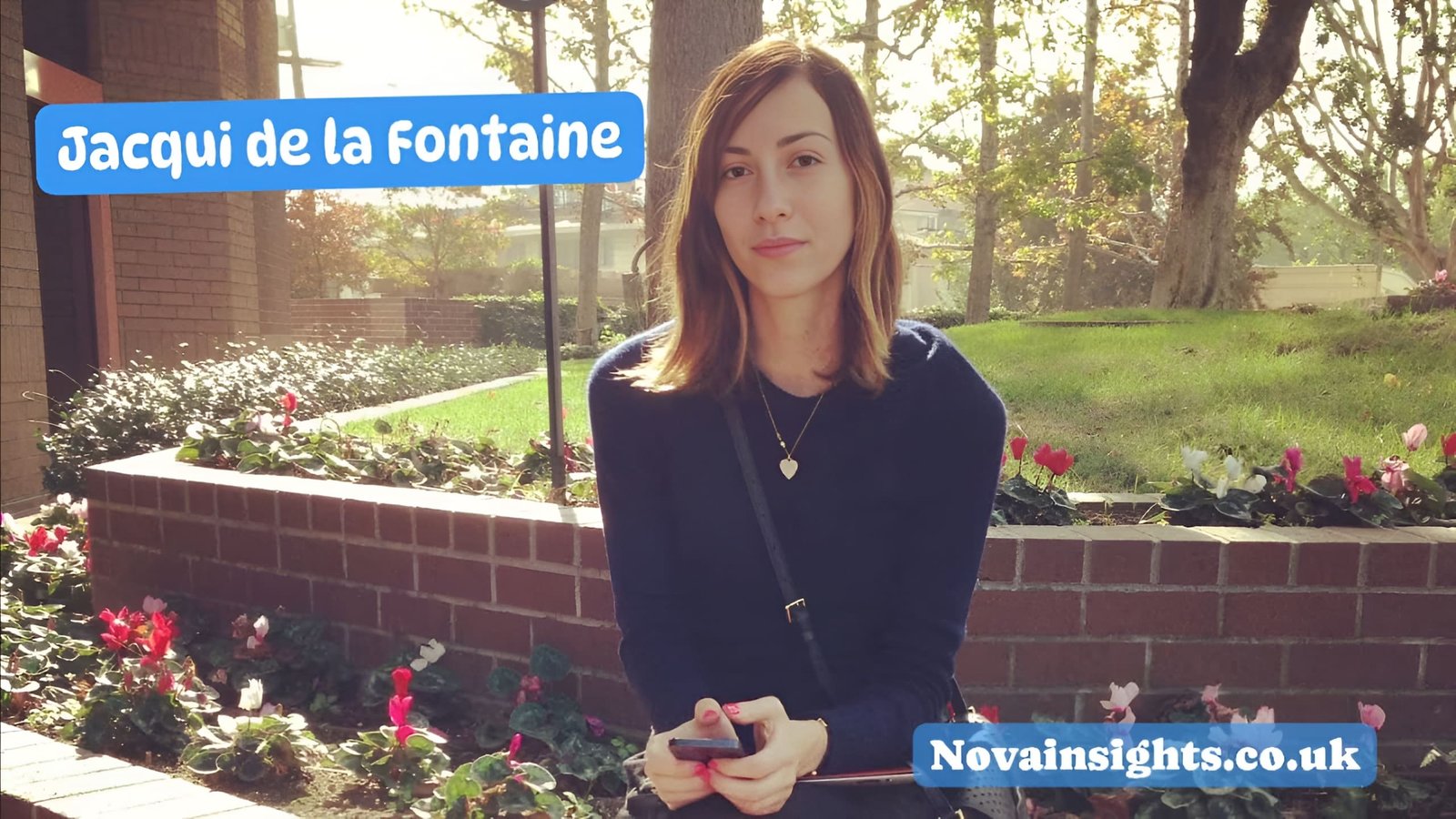
Jacqui de la Fontaine, also known as Jacqui Getty, is an American costume designer, fashion editor, and actress. She trained under legendary designers on The Godfather Part III, worked as a contributing editor at Harper’s Bazaar, styled major music artists in the 1990s, and is the mother of filmmaker Gia Coppola. Her life bridges the iconic Coppola and Getty dynasties.
Jacqui de la Fontaine is one of Hollywood’s quietly influential creative figures. Born in New York and raised in Los Angeles, she built her career in costume design, working on landmark films including The Godfather Part III and The Darjeeling Limited. In the 1990s, she became a go-to stylist for iconic music artists like the Beastie Boys, Green Day, and Daft Punk. Through the encouragement of Demi Moore, she transitioned into fashion journalism as a contributing editor at Harper’s Bazaar. Her personal life has been equally extraordinary — she was engaged to Gian-Carlo Coppola, son of Francis Ford Coppola, who died tragically in 1986 before their daughter Gia Coppola was born. She later married Peter Getty. Today, Jacqui remains a respected figure in Los Angeles creative circles, known for her bohemian style, resilience, and enduring Hollywood connections.
Quick Bio Table
| Detail | Information |
| Full Name | Jacqueline de la Fontaine (Jacqui Getty) |
| Born | Approx. 1967–1968, New York, USA |
| Raised In | Los Angeles, California |
| Nationality | American |
| Ethnicity | French and Italian ancestry |
| Occupation | Costume Designer, Fashion Editor, Actress, Producer |
| Famous For | Mother of filmmaker Gia Coppola; The Godfather Part III, The Darjeeling Limited |
| Education | Trained under Milena Canonero & Beatrix Aruna Pasztor |
| First Partner | Gian-Carlo Coppola (died 1986) |
| Marriage | Peter Getty (2000–2010, divorced) |
| Children | Gia Coppola (filmmaker) |
| Grandchild | Beaumont Titus |
| Residence | Hollywood Hills, Los Angeles |
| Net Worth (Est.) | $5 million – $10 million |
| Social Media | @jacquigetty / @spagettyos_ |
Who Is Jacqui de la Fontaine?
The Woman Behind Two of Hollywood’s Greatest Dynasties
Jacqui de la Fontaine is not a name that flashes across movie theater marquees, yet her fingerprints are all over some of the most memorable visual moments in modern entertainment. Born in New York and raised in Los Angeles, she grew up surrounded by the magnetic energy of Southern California’s creative world. From a young age, she was drawn to color, texture, and the quiet storytelling power of clothing. Her French and Italian heritage gave her an innate appreciation for romantic, layered aesthetics — a quality that would define her entire professional life. She represents the rare kind of Hollywood insider who shapes culture without seeking the spotlight, preferring instead to work behind the lens rather than in front of it.
A Childhood Shaped by Contrast and Creative Longing
Jacqui’s early years were not without hardship. Her mother was a former model and her father a restaurateur who left the family when Jacqui was just twelve years old. After his departure, her mother relocated them from New York to Los Angeles, where Jacqui attended Beverly Hills High School. This environment — where wealth and creative ambition sat side by side — shaped her perspective in powerful ways. She was not born into privilege, but she was born with taste, curiosity, and an unshakeable desire to make beautiful things. Those qualities would carry her further than any inheritance ever could.
From Beverly Hills Hallways to The Godfather Set
It was in Beverly Hills that Jacqui crossed paths with the world that would change her life forever. As a teenager, she met and fell in love with Gian-Carlo Coppola, the eldest son of legendary director Francis Ford Coppola. This connection pulled her into one of cinema’s most revered families. Through her relationship with Gian-Carlo, she gained access to film sets, creative conversations, and the electric atmosphere of professional moviemaking. She began learning the craft of costume design not in classrooms, but on real productions, absorbing knowledge like someone who had always belonged in that world. Her journey into Hollywood was personal as much as it was professional.
The Making of a Master Costume Designer
Learning From the Legends: Canonero and Pasztor
Jacqui de la Fontaine did not take the conventional route into professional costume design. Rather than formal film school or fashion college, she trained directly alongside two of the industry’s most accomplished designers — Milena Canonero and Beatrix Aruna Pasztor. These women had credits on major films including The Godfather Part III and My Own Private Idaho, and Jacqui absorbed their methods with the dedication of someone who understood that clothing in film is never merely decorative. Every garment tells a story, reveals a character’s psychology, and anchors a narrative in time and place. Under their mentorship, she developed a sophisticated visual language that would serve her across decades of work.
The Godfather Part III and Early Career Milestones
One of Jacqui’s earliest professional credits came through her work in the costume and wardrobe department on The Godfather Part III in 1990 — a production with extraordinary legacy. Working on a Francis Ford Coppola film at that stage of her career was both a privilege and a proving ground. She followed this with wardrobe roles on Single White Female in 1992 and acting credits in Jack in 1996. These early years established her reputation as someone who brought genuine skill and attention to detail, not just a famous last name. Her work was respected on its own terms, which set the foundation for everything that followed in her multi-decade creative career.
Also read this: Keith Levenson: The Legendary Conductor Who Bridged Broadway and Rock
Styling the Stage and Screen with Fearless Vision
Beyond major films, Jacqui’s talent extended to theatrical costume design. In 1999, she designed costumes for Francis Ford Coppola’s musical production of Gidget, blending her film sensibility with the demands of live performance. In recent years, she returned to the screen with projects including Love Is Love Is Love in 2020 and The Noel Diary in 2022. Her work on Wes Anderson’s The Darjeeling Limited further demonstrated her ability to bring a specific, meticulously crafted visual world to life. Each project added a new dimension to her professional identity — that of a creator who understands that great costume design is invisible when it works perfectly, and unforgettable when it transcends the ordinary.
Music, Fashion, and the Power of Cultural Styling
Dressing the Icons: Beastie Boys, Green Day, Daft Punk, and More
Perhaps the most underappreciated chapter of Jacqui de la Fontaine’s career unfolded not in cinemas but on television screens during the golden era of music videos. Throughout the 1990s, she became one of the most sought-after stylists for major recording artists. Her clients included the Beastie Boys, Green Day, Daft Punk, The Strokes, Faith Hill, Counting Crows, and Fatboy Slim. These were not small projects — these were videos that played on constant rotation on MTV and shaped how an entire generation understood cool. Millions of viewers saw her aesthetic choices without ever knowing her name, which is the quiet genius of great behind-the-scenes work.
How Demi Moore Changed Everything
The pivot in Jacqui’s career from costume design into the world of high fashion journalism came through an unexpected source — her close friend, actress Demi Moore. Having seen Jacqui’s extraordinary eye for style and visual storytelling, Moore encouraged her to channel that talent into editorial work. She introduced Jacqui to Glenda Bailey, the influential editor of Harper’s Bazaar, which opened the door to a new chapter entirely. Jacqui joined the magazine as a contributing editor, spending years shaping major photoshoots, collaborating with top photographers and models, and guiding the aesthetic direction of one of fashion’s most prestigious publications. This transition demonstrated her remarkable versatility as a creative professional.
Harper’s Bazaar, C Magazine, and WSJ Magazine
Jacqui’s editorial career at Harper’s Bazaar proved to be a natural extension of everything she had developed on film and music video sets. Her understanding of how clothing communicates, her sensitivity to mood and narrative, and her deep relationship with artists and designers made her an invaluable creative voice. Over time, she expanded her editorial contributions to include C Magazine and WSJ Magazine, further cementing her reputation as a tastemaker with genuine authority in both fashion and culture. She was not simply a stylist following trends — she was helping to create them, directing the visual conversation in the way that only someone with her depth of experience genuinely could.
Love, Loss, and the Coppola Connection
Gian-Carlo Coppola: A Love Cut Tragically Short
The most emotionally defining chapter of Jacqui de la Fontaine’s personal life began when she fell in love with Gian-Carlo Coppola in the mid-1980s. Gian-Carlo — known to friends as Gio — was a film producer and the eldest son of Francis Ford Coppola. By all accounts, their connection was deep and genuine. The two became engaged, and Jacqui became pregnant with their child. Then, on May 26, 1986, tragedy struck with devastating force. Gian-Carlo died in a boating accident on the Sacramento River at just twenty-two years old, leaving Jacqui pregnant, heartbroken, and facing the future alone. She was only nineteen years old. The loss was immeasurable, and it would shape everything that followed in her life.
Raising Gia: Strength Born from Grief
Seven months after Gian-Carlo’s death, on January 1, 1987, Jacqui gave birth to their daughter, Gia Coppola. The Francis Ford Coppola family embraced both Jacqui and the newborn Gia with extraordinary warmth, becoming a source of stability and belonging during an unimaginably difficult period. Francis Ford Coppola later dedicated his 1996 film Jack to Gia, with the inscription ‘When you see a shooting star.’ Jacqui raised her daughter with the full support of the Coppola family, splitting time between Los Angeles and the family’s vineyard in Napa Valley. This upbringing — surrounded by film, art, and creative legacy — had a profound impact on Gia, who would go on to become a filmmaker in her own right.
Gia Coppola: Hollywood’s Next Generation Director
The creative lineage that Jacqui helped nurture is visible in the extraordinary career of her daughter, Gia Coppola. Gia made her feature directorial debut with Palo Alto in 2013, an adaptation of James Franco’s short story collection that premiered at the Venice International Film Festival. She followed this with Mainstream in 2020, starring Andrew Garfield and Maya Hawke, and The Last Showgirl in 2024. Gia grew up watching her mother work — on costumes, on photoshoots, on music videos — and absorbed that creative discipline into her own filmmaking practice. Jacqui appeared alongside her daughter in Palo Alto, a fitting testament to their bond and shared love of the craft they both inherited from a family of storytellers.
Peter Getty, the Marriage, and a Turbulent Chapter
Love Found Again: Marrying Into the Getty Fortune
Several years after Gian-Carlo’s death, Jacqui de la Fontaine found love again — this time with Peter Getty, the son of Gordon Getty, one of America’s wealthiest figures. Peter was a Harvard graduate with a dry wit, a love of opera, and deep ties to San Francisco’s cultural elite. The couple married in 2000, and Jacqui took on the surname Getty. Peter became a stepfather to Gia Coppola, and the family became what Harper’s Bazaar would later call ‘the nexus of hipster Hollywood.’ Their home in Los Angeles served as a gathering place for creative luminaries including Leonardo DiCaprio, Demi Moore, Wes Anderson, Jason Schwartzman, and the Olsen twins. For nearly a decade, they represented a particular kind of glamorous, culturally sophisticated Los Angeles life.
The Divorce That Shocked Hollywood
The marriage between Jacqui and Peter Getty unraveled painfully and publicly. After separating in 2009, Jacqui filed for divorce and the proceedings became one of Los Angeles’ most discussed legal battles. Jacqui alleged serious physical and emotional abuse during the marriage. The case attracted significant media attention, both because of the dramatic nature of the allegations and because of the substantial financial assets involved, including a San Francisco home reportedly valued at twenty to thirty million dollars. High-profile attorneys represented both sides, and the case wound through the courts for several years. The divorce was finalized in 2010, closing a chapter that had brought both extraordinary joy and profound suffering into Jacqui’s life.
Life After Getty: Rebuilding with Creativity and Grace
Following the end of her marriage to Peter Getty, Jacqui de la Fontaine rebuilt her life with characteristic grace and quiet determination. She returned to her creative work in earnest, taking on new projects in both film and fashion. She continued living in the Hollywood Hills home she had shared with Gia, a warm Mediterranean-style property widely reported to have been gifted by Francis Ford Coppola. Inside its walls, she curated a space that felt like a living museum of her personal and professional history — filled with art, vintage fashion, and personal artifacts. She became a grandmother with the arrival of Gia’s son, Beaumont Titus, and her focus shifted naturally toward family, creativity, and the next generation of storytellers she had helped shape.
Style, Aesthetic, and Life in the Hollywood Hills
A Personal Aesthetic That Became Her Signature
Anyone who has encountered Jacqui de la Fontaine in photographs or at events understands immediately that her personal style is as carefully considered as any costume she has ever designed. She gravitates toward soft vintage silhouettes, long dark hair, flowing earth tones, and bohemian layers that feel simultaneously effortless and deeply intentional. During the mid-2000s, she regularly appeared on Best Dressed lists for events like the LACMA Art and Film Gala, where her aesthetic stood out even in a room full of Hollywood’s most polished figures. Her style is not about trends — it is about identity, history, and the quiet confidence of someone who has spent decades understanding how clothing communicates character.
The Hollywood Hills Home: A Creative Sanctuary
Jacqui’s home in the Hollywood Hills has become something of a legend among the Los Angeles creative community. With its warm Mediterranean architecture and rooms filled with carefully chosen art pieces, vintage clothing, and personal treasures from a life lived at the intersection of film and fashion, the house reflects its owner completely. According to multiple reports, the property was gifted to Jacqui by Francis Ford Coppola following the death of Gian-Carlo — a gesture of extraordinary generosity from a family that had already taken her in as one of their own. The home became the setting for many of Hollywood’s most celebrated informal gatherings during the decade when Jacqui and Peter Getty were together.
Social Media, Public Presence, and Quiet Influence
In the age of social media, Jacqui maintains a deliberately quiet but distinct presence. On Instagram, she shares under handles including @jacquigetty and @spagettyos_, posting images that feel like pages from a personal diary — art that moves her, moments with family, fashion that catches her eye, and glimpses into the Hollywood Hills life she has curated over decades. Her feed is the opposite of manufactured influencer content. It is personal, warm, and occasionally surprising. This understated online presence mirrors how she has always operated in Hollywood — present, influential, and utterly uninterested in performing for an audience larger than the one she actually cares about. Her real power has always come from genuine relationships and authentic creative work.
Legacy, Impact, and What Jacqui de la Fontaine Means to Hollywood
A Career That Defies Easy Categorization
It is tempting to define Jacqui de la Fontaine by her relationships — the Coppola fiancée, the Getty wife, the mother of Gia. But doing so fundamentally misses the point of who she is. Jacqui is, above all else, a creative professional with a career that spans more than three decades and crosses multiple disciplines. She is a costume designer whose instincts shaped major films. She is a fashion editor who guided the visual tone of one of the world’s premier style publications. She is a stylist who helped define the visual identity of an entire era of popular music. And she is an actress who brought something genuine to the screen when she chose to appear. Each of these identities is real, and none of them can be reduced to someone else’s story.
The Quiet Influence of a Creative Matriarch
What makes Jacqui de la Fontaine’s story genuinely compelling is not just what she survived, but what she built through it. She lost her partner at nineteen while pregnant with their child. She endured a painful and public marriage breakdown. She navigated the extraordinary pressure of living at the intersection of two of America’s most famous dynasties. And through all of it, she maintained her creative identity, raised a daughter who became a filmmaker, and continued producing work that stands on its own merit. Her influence on Gia Coppola’s sensibility — the visual intelligence, the attention to detail, the comfort with complex emotional material — is visible in every film Gia has made. That is the most lasting kind of legacy.
What the Future Holds for Jacqui and Her Legacy
As of 2026, Jacqui de la Fontaine continues to work in the creative industries, though with the measured selectivity of someone who has earned the right to choose her projects carefully. She is a grandmother, a creative collaborator, a keeper of Hollywood history, and a woman whose story deserves to be told fully and on its own terms. The house in the Hollywood Hills, reportedly now on the market, represents both an ending and the beginning of a new chapter. Whatever comes next for Jacqui, she carries with her the knowledge that she lived one of Hollywood’s most extraordinary lives — not because of who she married or who gave birth to her, but because of who she consistently chose to be: a creator, a survivor, and an irreplaceable original.
Conclusion
Jacqui de la Fontaine is a woman whose life reads like a great Hollywood screenplay — full of love and tragedy, creativity and resilience, glamour and hard-won wisdom. From her early days learning costume design on The Godfather Part III to her years shaping the pages of Harper’s Bazaar, from her devastating loss of Gian-Carlo Coppola to her role as mother of one of cinema’s rising directors, Jacqui has navigated an extraordinary existence with uncommon grace. Her story reminds us that the most interesting people in Hollywood are often those who work slightly to the side of the spotlight — quietly making everything more beautiful, more meaningful, and more alive.
Frequently Asked Questions (FAQs)
1. Who is Jacqui de la Fontaine?
Jacqui de la Fontaine, also known as Jacqui Getty, is an American costume designer, fashion editor, and actress. She is best known as the mother of filmmaker Gia Coppola and for her work on films including The Godfather Part III and The Darjeeling Limited.
2. Who is Gia Coppola’s mother?
Gia Coppola’s mother is Jacqui de la Fontaine. Gia’s father was Gian-Carlo Coppola, the son of director Francis Ford Coppola, who died in a boating accident in 1986 before Gia was born.
3. Was Jacqui de la Fontaine married to Peter Getty?
Yes. Jacqui married Peter Getty, son of Gordon Getty, in 2000. They separated in 2009 and their divorce was finalized in 2010. The divorce proceedings attracted significant media attention due to serious allegations and substantial financial assets.
4. What films did Jacqui de la Fontaine work on?
She worked on The Godfather Part III (1990), Single White Female (1992), Jack (1996), The Darjeeling Limited, Love Is Love Is Love (2020), The Noel Diary (2022), and Palo Alto (2013) alongside her daughter Gia Coppola.
5. What is Jacqui de la Fontaine’s net worth?
Jacqui de la Fontaine’s net worth is estimated between $5 million and $10 million, earned through her long career as a costume designer, fashion editor, and actress across film, television, and editorial work.
6. Who did Jacqui de la Fontaine style in music videos?
In the 1990s, she styled major artists including the Beastie Boys, Green Day, Daft Punk, The Strokes, Faith Hill, Counting Crows, and Fatboy Slim, making her one of the most prolific music video stylists of that era.
7. What is Jacqui de la Fontaine’s connection to Harper’s Bazaar?
Actress Demi Moore encouraged Jacqui to move into fashion journalism and introduced her to editor Glenda Bailey. Jacqui subsequently joined Harper’s Bazaar as a contributing editor, later also contributing to C Magazine and WSJ Magazine.
Fore more info: Novainsights.co.uk
