
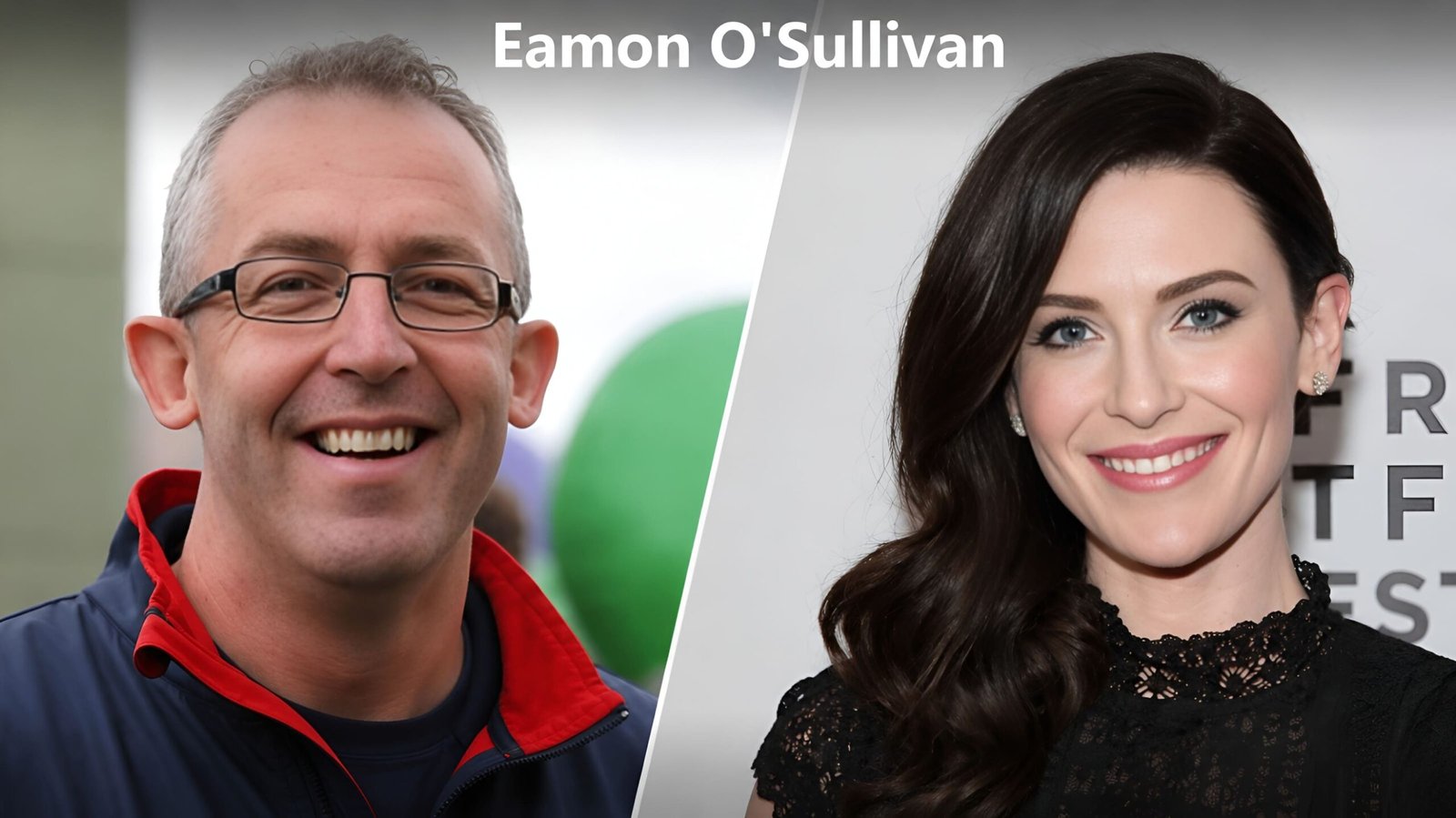
Dr. Eamon O’Sullivan (1897–1966) was an Irish psychiatrist, athlete, and Gaelic football trainer who led the Kerry GAA team to eight All-Ireland championship victories across nearly four decades. He is widely regarded as one of the greatest coaches in GAA history. The name is also shared by Bridget Regan’s husband — a writer she met in New Zealand.
Quick Bio Table
| Detail | Dr. Eamon O’Sullivan (GAA Legend) | Eamon O’Sullivan (Bridget Regan’s Husband) |
| Full Name | Edward “Eamon” O’Sullivan | Eamon O’Sullivan |
| Born | 8 May 1897, Firies, Co. Kerry, Ireland | Not publicly disclosed |
| Died | 1966 | N/A (Living) |
| Profession | Psychiatrist, GAA Trainer, Sports Administrator | Writer |
| Notable For | 8 All-Ireland Kerry victories | Married to actress Bridget Regan |
| Education | UCD Medical School (qualified 1925) | Not publicly disclosed |
| Key Work | The Art and Science of Gaelic Football (1958) | N/A |
| Nationality | Irish | Irish |
Who is Eamon O’Sullivan? The Legendary Kerry Football Trainer
Eamon O’Sullivan was not just a great trainer — he was a product of Kerry’s deep GAA heritage. Born on 8 May 1897 in Ballincarrig, Firies, County Kerry, he was the only son of James “J.P.” O’Sullivan, a celebrated local athlete and GAA organiser. Growing up immersed in Gaelic games, Eamon inherited both a passion for sport and a fierce commitment to the Irish cultural identity that Gaelic football represented. This deep-rooted connection to Kerry soil would define his entire life and legacy.
His father’s early death in 1909 — when Eamon was just eleven years old — forced the young boy to mature quickly. He was sent to Castleknock College in Dublin, where his sporting instincts remained firmly with the Gaelic code. Even as a teenager, he resisted any influence toward foreign sports such as soccer or rugby, a stance he maintained passionately throughout his entire life. This iron loyalty to Irish cultural values shaped everything he later achieved.
From Theology Student to Medical Doctor
Before becoming a doctor, Eamon O’Sullivan briefly pursued the priesthood, spending nine months at the Irish Pontifical College in Rome. It was here, during lectures on theology and philosophy, that he first developed a deep interest in human psychology — a subject that would later inform his legendary coaching philosophy. He concluded that medicine, not the church, was his true calling, and returned to Ireland in November 1919 to study at University College Dublin.
At UCD, O’Sullivan excelled not only academically but athletically. He captained the university’s Sigerson Cup Gaelic football side and also represented UCD in the Dublin county championship in 1923–24. As a field athlete, he won the intervarsity javelin title in 1922, showcasing a broad sporting range. He qualified as a medical doctor in 1925, and became the first president of the Irish National Union of Students in 1924 — a distinction that speaks to his natural leadership abilities.
The Making of a Coaching Philosophy
What separated Eamon O’Sullivan from every other GAA trainer of his era was the way he applied psychiatric and psychological principles to athletic performance — decades before sports psychology became a recognised discipline. Working as Resident Medical Superintendent at St. Finan’s Mental Hospital in Killarney, he observed human behaviour, motivation, and group dynamics daily. He brought those observations directly onto the football training pitch, creating a coaching method that was genuinely ahead of its time.
His approach emphasised collective preparation, teamwork, positional discipline, and mental strength. He believed deeply that even ordinary players could be elevated through structured training, strong team identity, and proper psychological preparation. He reportedly turned mediocre footballers into effective ones through this method. His style of football — a hard, fair “catch and kick” game — built Kerry’s reputation as the gold standard of Gaelic football for over thirty years.
Eight All-Ireland Titles: A Record That Speaks for Itself
The simplest measure of Eamon O’Sullivan’s greatness is this: he trained the Kerry senior football team to eight All-Ireland championship victories across a remarkable 39-year period. Those victories came in 1924, 1926, 1937, 1946, 1953, 1955, 1959, and 1962 — a span touching five separate decades. No other individual in Kerry football history has matched this record, except Mick O’Dwyer who later equalled it. The sheer consistency and longevity of O’Sullivan’s success is without precedent in Irish sport.
What makes this record even more impressive is the era in which it was achieved. There were no modern facilities, no full-time training squads, no video analysis. O’Sullivan worked with what he had — a loyal county, committed players, and a brilliant mind. He organised collective training sessions for the squad ahead of semi-finals and finals, a practice so progressive that the GAA actually banned it in the 1950s, viewing it as a step toward professionalism. History has since proved him entirely right.
Occupational Therapy Pioneer and Medical Visionary
It would be a disservice to reduce Eamon O’Sullivan to football alone. As Resident Medical Superintendent at St. Finan’s Mental Hospital in Killarney, he was a genuine pioneer in occupational therapy — the use of practical activity to treat and rehabilitate patients with mental illness. Long before this approach became standard psychiatric practice across Ireland and Britain, O’Sullivan was implementing it in rural Kerry. His patients participated in meaningful work, craft, and physical activity as part of their treatment.
His dual career as a psychiatrist and a football trainer was no coincidence. He believed fundamentally in the healing power of structured activity, teamwork, and purpose — whether for a psychiatric patient or a Kerry corner-back preparing for Croke Park. This philosophical overlap made him unique. In one extraordinary and controversial episode, he organised patients from St. Finan’s to assist in the physical construction of Fitzgerald Stadium in Killarney, which he helped develop as a memorial to the great Dick Fitzgerald.
The Art and Science of Gaelic Football: A Landmark Book
In 1958, Eamon O’Sullivan published The Art and Science of Gaelic Football — the second major coaching manual in GAA history, following Dick Fitzgerald’s How to Play Gaelic Football from 1914. This book codified O’Sullivan’s entire coaching philosophy: his training methods, tactical principles, physical preparation routines, and his belief in the psychological dimensions of the game. It remains a historical landmark in Irish sporting literature and a testament to the intellectual depth he brought to what others treated merely as recreation.
The book drew on three decades of practical coaching experience and was written with the precision of a medical professional. Sections of the text detailed collective training schedules, positional responsibilities, and the mental attitudes required for championship football. Decades later, counties travelling to Spain and Portugal for pre-championship training camps are, in a sense, fulfilling O’Sullivan’s original vision — one he had pioneered long before it was fashionable or even officially permitted.
GAA Administration: Building the Organisation He Loved
Beyond coaching and medicine, Eamon O’Sullivan was a significant force in the administrative structures of the GAA. He was instrumental in reorganising athletics in Kerry and helped establish the Kerry board of the National Athletic and Cycling Association of Ireland (NACAI) in 1926, serving as its secretary until 1932. He was elected national president of the NACAI in 1929 — a reflection of the respect he commanded at a national level far beyond Kerry’s borders.
Within the GAA itself, he served as secretary and president of the Dr Croke’s club in Killarney, one of the county’s most storied clubs. He also served as president of the Kerry county board of the GAA and played a central role in developing colleges football in the county. He was responsible for setting up the interprovincial colleges competition, a structure that endures to this day. Every layer of Irish Gaelic sport bears some imprint of his organisational energy.
Legacy and Influence on Modern GAA Coaching
The legacy of Eamon O’Sullivan in modern GAA coaching is both direct and profound. The entire concept of collective pre-championship training — now universal — traces its origin to his pioneering work. His insistence on sports psychology, mental preparation, and team cohesion anticipated the frameworks that modern performance coaches apply as standard. He understood, decades before the research confirmed it, that the mind is at least as important as the body in elite sport.
A biography, Eamon O’Sullivan: A Man Before His Time, written by the late Weeshie Fogarty and published in 2007, helped reintroduce his story to a new generation of Kerry supporters. Pat O’Shea, who later managed Kerry, described him as one of the greatest Kerrymen of all time — a true visionary in both sport and medicine. His influence on Kerry football’s culture of excellence is immeasurable, and every All-Ireland that Kerry has won since 1924 carries something of his spirit.
The Only All-Ireland Final He Lost
Despite his extraordinary record, Eamon O’Sullivan was not infallible. He trained the Kerry team that lost the 1965 All-Ireland final to Galway — the only All-Ireland final he lost in his entire career as trainer. He also oversaw the County’s surprise defeat to Waterford in the 1957 Munster championship, a result that shocked the entire country. These rare setbacks actually enhance rather than diminish his legacy: they remind us that even greatness operates within the realm of sport’s unpredictability.
By the early 1960s, the physical, direct game championed by O’Sullivan — the classic Kerry “catch and kick” style — was being challenged by the more athletic, running game introduced by Joe McCartan’s Down teams. The sport was evolving, and even the greatest coaching mind of the era had to adapt. O’Sullivan embraced the challenge with the same intellectual curiosity he brought to everything else in his life, continuing to refine his methods until the very end of his career.
Who is Bridget Regan? Hollywood Star and Wife of Eamon O’Sullivan
Bridget Regan is a celebrated American actress and producer born on February 3, 1982, in Carlsbad, California. She grew up performing in local theatre productions, including The Wizard of Oz at the La Paloma Theatre, and went on to earn a Bachelor of Fine Arts in Drama from the University of North Carolina School of the Arts in 2004. After graduating, she moved to New York City to pursue her professional acting career — a decision that would lead her around the world, and ultimately, to her husband Eamon O’Sullivan.
Her breakout role came as Kahlan Amnell in the ABC adventure series Legend of the Seeker (2008–2010), based on Terry Goodkind’s Sword of Truth fantasy novels. The show was largely filmed in New Zealand, and it was during that production that Bridget Regan met and fell in love with Irish writer Eamon O’Sullivan. The couple married and have two children together — a daughter named Frankie Jean O’Sullivan and a son named Bernard Moon O’Sullivan. The love story that began on a New Zealand film set has created a uniquely Irish-American family.
The Connection Between Bridget Regan and Her Husband Eamon O’Sullivan
The Eamon O’Sullivan who married Bridget Regan is an Irish writer — a very different figure from the legendary Kerry GAA trainer, yet the shared name creates an interesting bridge between two worlds. Bridget has spoken warmly about her husband in various interviews, describing a partnership built on creativity, shared values, and a love of storytelling. The couple met while Bridget was filming in New Zealand, where many of Eamon’s creative and personal interests brought him into her orbit during production.
Their family life blends Irish and American cultural identities, and both parents are known to be deeply private about their children. Eamon O’Sullivan, as Bridget’s husband, occupies a different kind of legacy from his famous Kerry namesake — but both men carry the same name with a certain quiet dignity. The actress continues to build one of the most impressive careers in American television, while Eamon remains a supportive presence in her professional journey and a devoted father to their two children.
Bridget Regan’s Career: Villains, Warriors, and Iconic Roles
Bridget Regan has built a reputation for playing complex, commanding characters across more than two decades of work in film and television. Following Legend of the Seeker, she delivered standout recurring roles as Rebecca Lowe/Rachel Turner in USA Network’s White Collar, Rose Solano in The CW’s critically acclaimed Jane the Virgin, Dottie Underwood (Marvel’s original Black Widow) in Agent Carter, and Sasha Cooper in TNT’s The Last Ship. Each role demonstrated her extraordinary range.
Most recently, she starred in Amazon MGM Studios’ Sarah’s Oil and has appeared on The Rookie, where TVLine declared her performance “so commanding it deserves her own spinoff series.” She also brought DC’s Poison Ivy to life in Batwoman, receiving universal acclaim from critics and comic book fans alike. Film credits include a role in John Wick opposite Keanu Reeves and Paradise Lost opposite Josh Hartnett and Nick Nolte. Upcoming projects include recurring roles on Netflix’s Ransom Canyon and Matlock opposite Kathy Bates.
How Both Eamon O’Sullivans Connect: Heritage, Legacy, and Family
The two men named Eamon O’Sullivan represent very different chapters of Irish life — one a mid-twentieth century sporting and medical genius who shaped the national identity of Kerry GAA, the other a contemporary Irish writer who became part of one of Hollywood’s more quietly admired families. Yet both figures are defined by their relationship to their communities, their craft, and the people around them. The GAA legend gave Kerry eight All-Ireland titles; Bridget Regan’s Eamon gave her a family and a home.
What unites both stories is the quiet, enduring power of the O’Sullivan name in Irish culture. Dr. Eamon O’Sullivan built institutions, wrote landmark books, and transformed how Irish sport understood the human mind. Eamon O’Sullivan the writer found love in New Zealand and built a life with one of America’s most talented actresses. Together, these two stories paint a portrait of how a single Irish surname can carry both historic greatness and modern, personal beauty across the generations.
Conclusion
Eamon O’Sullivan is a name that carries extraordinary weight in Irish sporting history. The legendary Dr. Eamon O’Sullivan — psychiatrist, coach, administrator, and author — remains the defining architect of Kerry GAA’s identity, a man whose 39-year career produced eight All-Ireland titles and a philosophy of coaching that the entire sport still follows today. His book, his medical work, his administrative legacy, and his pioneering methods mark him as one of the most original minds in twentieth-century Irish public life.
The contemporary Eamon O’Sullivan, known to the world as the husband of actress Bridget Regan, carries that same storied Irish name into the modern era with equal grace. Together, these two figures remind us that a name is never just a name — it is a vessel for history, character, and legacy. Whether on the training pitches of Killarney or the film sets of New Zealand, the name Eamon O’Sullivan represents something genuinely worth knowing.
Frequently Asked Questions (FAQs)
Q1. Who was Dr. Eamon O’Sullivan?
Dr. Eamon O’Sullivan (1897–1966) was an Irish psychiatrist and Gaelic football trainer who guided the Kerry senior football team to eight All-Ireland championship titles across 39 years, making him one of the greatest coaches in GAA history.
Q2. How many All-Ireland titles did Eamon O’Sullivan win with Kerry?
He trained Kerry to eight All-Ireland victories, in 1924, 1926, 1937, 1946, 1953, 1955, 1959, and 1962 — a record he shares only with Mick O’Dwyer.
Q3. What book did Dr. Eamon O’Sullivan writes?
He published The Art and Science of Gaelic Football in 1958, which is considered one of the most important coaching manuals ever written in the GAA.
Q4. Who is Eamon O’Sullivan married to?
The contemporary Eamon O’Sullivan is married to American actress Bridget Regan. The couple met in New Zealand while Bridget was filming Legend of the Seeker and have two children together.
Q5. What is Bridget Regan best known for?
Bridget Regan is best known for her roles as Kahlan Amnell in Legend of the Seeker, Rose Solano in Jane the Virgin, Dottie Underwood in Agent Carter, and Poison Ivy in Batwoman.
Q6. Was Eamon O’Sullivan a psychiatrist?
Yes. Dr. Eamon O’Sullivan was the Resident Medical Superintendent at St. Finan’s Mental Hospital in Killarney and was a pioneer in occupational therapy in Ireland.
Q7. What was Eamon O’Sullivan’s coaching philosophy?
He believed in collective training, psychological preparation, teamwork, and a disciplined “catch and kick” style of play. He applied psychiatric principles to athletic coaching decades before sports psychology became mainstream.
Fore more info: Novainsights.co.uk
