
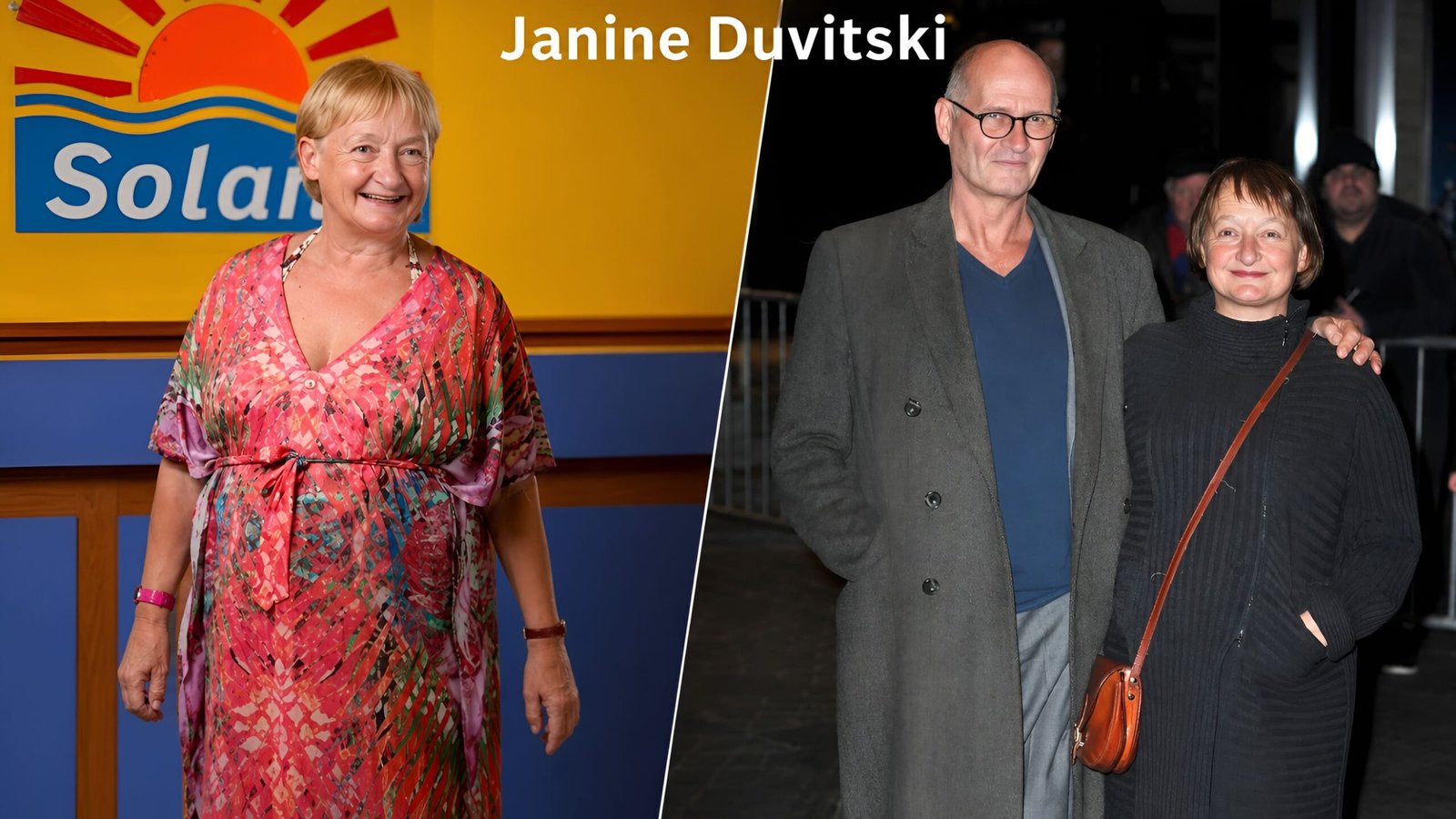
Janine Duvitski (born Christine Janine Drzewicki on 28 June 1952 in Morecambe, Lancashire) is a celebrated British actress best known for her roles in Waiting for God, One Foot in the Grave, and Benidorm. She trained at East 15 Acting School and rose to fame through Mike Leigh’s Abigail’s Party in 1977. She has been married to fellow British actor Paul Bentall since 1983, and together they have four children, including actress Ruby Bentall.
Quick Bio Table
| Detail | Information |
| Full Birth Name | Christine Janine Drzewicki |
| Stage Name | Janine Duvitski |
| Date of Birth | 28 June 1952 |
| Birthplace | Morecambe, Lancashire, England |
| Nationality | British |
| Education | East 15 Acting School, Essex |
| Occupation | Actress (TV, Film, Theatre) |
| Years Active | 1972 – Present |
| Spouse | Paul Bentall (married 1983) |
| Children | 4 — Jack, Albert, Ruby, and Edith Bentall |
| Notable Roles | Waiting for God, One Foot in the Grave, Benidorm, Abigail’s Party |
| Residence | London, England |
Who Is Janine Duvitski?
Janine Duvitski is one of Britain’s most distinctive and enduring actresses, a performer who has consistently delivered sharp, nuanced, and deeply human portrayals across television, theatre, and film for more than five decades. Born Christine Janine Drzewicki on 28 June 1952 in Morecambe, Lancashire, she adopted a phonetic version of her Polish surname as her stage name — Duvitski — because she feared audiences would never know how to pronounce Drzewicki. That small creative decision turned into one of the most recognisable names in British entertainment, associated with warmth, precision, and an uncommon gift for comedic character work.
Growing up in Nottingham with a Polish father and an English mother, Duvitski was shaped by a culturally rich household that gave her a broader perspective on people and their personalities. She attended Nottingham Girls’ High School before pursuing her passion at the prestigious East 15 Acting School in Essex, where she developed the vocal, physical, and emotional foundations of a career that would go on to span over 50 years. Her journey was never the overnight success story; it was built brick by brick, role by role, stage night by stage night, until her name became synonymous with some of the most beloved British comedy characters of the modern era.
The Early Career That Set the Stage for a British Comedy Legend
After leaving East 15, Janine Duvitski navigated the challenging early years of an acting career with resourcefulness and determination. Unable to immediately secure an agent, she reportedly placed an advertisement to find one — a very un-glamorous start for someone who would later become a household name. Her persistence paid off when the BBC invited her to audition for a BBC2 Playhouse production, casting her as a 13-year-old girl despite her being in her early 20s. Her convincing performance not only won her the role but opened critical doors in television and theatre casting networks.
These early television credits gave her enough exposure to attract the attention of the industry’s more discerning directors. Her work in theatre during this period was equally important, as it was during a production at Hampstead Theatre that the acclaimed filmmaker Mike Leigh noticed her. That chance encounter led to the role that would permanently alter the trajectory of her professional life and place her at the heart of one of British television’s most revered dramatic productions. The foundation she built in these formative years — humble, methodical, grounded — would later be visible in every character she created.
Abigail’s Party: The Mike Leigh Breakthrough That Made Britain Take Notice
In 1977, Janine Duvitski was cast by Mike Leigh in the stage production of Abigail’s Party, playing the character of Angie — an awkward, slightly dim but oddly endearing young woman navigating an excruciating suburban dinner party. The play opened at Hampstead Theatre in April 1977 and ran for 104 performances across two stints, accumulating a devoted following for its razor-sharp social commentary and brilliantly observed characterisation. Duvitski’s portrayal of Angie captured something profoundly real about a certain type of English social anxiety, delivering laughs that came from recognition rather than caricature.
The true breakthrough came when the BBC televised Abigail’s Party as part of its Play for Today strand, exposing the production to a national audience of millions. Overnight, the performances — including Duvitski’s — became part of British cultural conversation. The television version became a landmark piece of British drama, regularly cited among the greatest productions ever made for British TV. For Duvitski, it was the launchpad she needed, demonstrating conclusively to casting directors and producers that she possessed the rare ability to inhabit a character so fully that the performance felt lived-in rather than performed. Her career never looked back.
Waiting for God: Bringing Jane Edwards to Life on British Television
The early 1990s saw Janine Duvitski secure one of the defining roles of her career — Jane Edwards in the BBC sitcom Waiting for God. The show, set in a retirement home and following the adventures of two eccentric elderly residents, required a supporting cast capable of holding its own against strong lead performances. Duvitski played Jane with a combination of well-meaning naivety and comic vulnerability that made her instantly loveable. Jane was the kind of character who tries desperately to do the right thing and almost always gets it wrong — a perfect vehicle for Duvitski’s particular blend of physical comedy and emotional honesty.
Waiting for God ran for five series between 1990 and 1994, giving Duvitski a sustained platform to develop the character across dozens of episodes. The show attracted strong ratings and helped cement her status as one of British television’s most reliable comic performers. Her ability to find genuine warmth inside essentially foolish characters was on full display throughout the series, and the affection audiences developed for Jane Edwards reflected the quality of Duvitski’s performance. The role remains one of the most frequently discussed of her long career, beloved by viewers who grew up watching British sitcoms in that golden era.
One Foot in the Grave: Playing Pippa Trench with Perfect Comic Timing
Alongside her work in Waiting for God, Janine Duvitski also appeared in the enormously popular BBC sitcom One Foot in the Grave, playing the wonderfully named Pippa Trench — a neighbour of the eternally irritable Victor Meldrew. While Victor’s long-suffering wife Margaret provided the emotional centre of the show alongside its irascible lead, the supporting characters were crucial in creating the texture of the suburban world Victor continually raged against. Pippa was slightly scatter-brained, relentlessly cheerful, and blissfully unaware of the social carnage she often contributed to — a character designed precisely for Duvitski’s comedic strengths.
Her appearances in One Foot in the Grave were among the most enjoyable the series produced, largely because Duvitski understood intuitively how to play against Richard Wilson’s magnificent grumpiness without undermining it. She wasn’t the butt of the jokes so much as an unwitting catalyst for them, which is a far more subtle and demanding comic role. Her timing was impeccable — she knew precisely when to deliver a line deadpan, when to let confusion register on her face, and when silence was funnier than speech. These performances reinforced her reputation as a specialist in British comedy character work of the highest order.
Benidorm: The ITV Holiday Comedy That Reintroduced Her to a New Generation
From 2007 through to 2018, Janine Duvitski appeared across all ten series of Benidorm, the hugely successful ITV comedy set at a sun-soaked Spanish resort. She played Jacqueline Stewart, one half of an unconventional and memorably eccentric couple whose behaviour at the Solana resort provided consistent entertainment for millions of viewers. Appearing in 73 episodes over more than a decade, her commitment to the character and the production was extraordinary, and her portrayal of Jacqueline — with all her quirks, inappropriateness, and surprising moments of genuine feeling — became one of the most iconic in the show’s run.
Benidorm attracted a broad and loyal viewing audience throughout its run, and Duvitski’s presence was consistently one of its most celebrated elements. The character of Jacqueline required her to balance broad physical comedy with occasional moments of real emotional honesty, a balance she managed with characteristic ease. Working alongside a large ensemble cast that included Jake Canuso, Steve Pemberton, and many others, she demonstrated once again that her particular skill set — the ability to find humanity inside the most ridiculous of characters — translated perfectly to mainstream television comedy. The show gave her career a significant second wind and introduced her work to viewers who may not have grown up with Waiting for God.
Film Career: From Dracula to The Madness of King George and Beyond
While television has been the primary stage for Janine Duvitski’s career, she has also maintained a consistent presence in British cinema over the decades, though her film roles have typically been supporting or cameo appearances rather than starring turns. One of her earliest film credits came in the 1979 Dracula adaptation, where she appeared alongside the legendary Laurence Olivier and Donald Pleasence, gaining valuable experience on a major studio production. The following year, she featured in Breaking Glass, the 1980 rock music film that captured the energy of the British punk and new wave era.
In 1994, she appeared in the acclaimed period film The Madness of King George, which starred Nigel Hawthorne and earned international recognition, including Academy Award nominations. The film demonstrated that Duvitski’s abilities extended naturally into formal dramatic territory. Her subsequent film appearances include About a Boy (2002) with Hugh Grant, The New World (2005), and Angel (2007). These credits may not represent the most prominent strand of her career, but they illustrate her consistent professional activity and the breadth of productions willing to draw on her talent across various genres and formats.
Stage Legacy: A Theatre Career Rooted in Craft and Commitment
Long before the cameras found her, Janine Duvitski was a theatre actress, and the stage has remained a vital part of her professional identity throughout her career. Her training at East 15 gave her a rigorous grounding in the physical and technical demands of live performance — skills that translated directly into her distinctive screen presence. The stage requires an actor to sustain a character through sustained effort and consistency night after night, a discipline that Duvitski brought to every production she appeared in and that shaped her approach to all her subsequent television and film work.
Her theatre career has taken in productions across London’s major venues, including the Hampstead Theatre where Mike Leigh first spotted her potential. Throughout the 1980s and beyond, she balanced stage appearances with her growing television profile, never abandoning live performance in favour of the more commercially lucrative world of screen acting. This commitment to theatre reflects something fundamental about her professional values — a belief that the craft of acting is served best by remaining in touch with its most demanding and direct form. Audiences fortunate enough to see her on stage have consistently reported performances of real depth and intelligence.
The Stage Name and Polish Heritage: Understanding the Duvitski Story
One of the most interesting aspects of Janine Duvitski’s professional identity is the story behind her stage name. Born Christine Janine Drzewicki, she made the practical decision early in her career to adopt a phonetically simplified version of her surname to spare both herself and audiences the confusion that her Polish family name might generate. Duvitski is essentially an anglicised phonetic rendering of Drzewicki, preserving the sound while making it pronounceable to English speakers who might otherwise stumble over the unusual consonant cluster. It is a small but revealing detail about how she has always approached her craft — practically, thoughtfully, and with an eye on the audience’s experience.
Her Polish heritage, inherited from her father, is a thread that runs quietly through her life story without necessarily being visible in her work. The blend of Polish and English cultural identity gave her a dual perspective that may well have informed the sensitivity with which she has always approached characters — particularly those who feel slightly out of step with their environment, which describes many of her most memorable creations. From Angie in Abigail’s Party to Jane in Waiting for God to Jacqueline in Benidorm, there is often something slightly displaced about the characters she plays, something that sets them apart from the world around them.
Personal Life: Marriage, Family, and Life in London
Away from the spotlight, Janine Duvitski has built a stable, grounded personal life centred on family and long-term partnership. She has been married to British actor Paul Bentall since 1983, a relationship that has endured for over four decades and produced four children: Jack, Albert, Ruby, and Edith Bentall. The family has remained based in London, maintaining a relatively private existence compared to many in the entertainment industry. The longevity of the marriage is notable in an industry not always known for stable personal relationships, and it speaks to the values that both Duvitski and Bentall have consistently demonstrated in their professional lives as well.
Perhaps the most publicly recognised aspect of the family’s creative legacy is daughter Ruby Bentall, who has followed her parents into acting and built her own impressive screen career. Ruby has appeared in productions including Lark Rise to Candleford and numerous other television and film roles, demonstrating that the Duvitski-Bentall household clearly nurtured a creative environment that encouraged artistic development. Daughter Edith has pursued a different branch of the performing arts as the lead singer of the band FOURS, while sons Jack and Albert have maintained lower public profiles. The family represents a remarkable collective contribution to British performance culture.
Who Is Paul Bentall? The Talented Actor Who Shares Her Life and Legacy
Paul Bentall, born Paul Christopher Bentall on 29 September 1948 in Westminster, London, is a British actor whose career has spanned more than five decades across theatre, television, and film. Like his wife, he pursued professional training before entering the industry, developing a strong foundation in stage performance that has underpinned all his subsequent work. He is perhaps best known to film audiences for his role in Flash Gordon (1980) and has appeared in notable productions including First Knight (1995) with Sean Connery and Richard Gere, The World’s End (2013), and The Best Exotic Marigold Hotel (2011) alongside Judi Dench and Maggie Smith.
Bentall’s theatre credentials are particularly impressive, including work with the Royal National Theatre and appearances in major West End productions. His stage work has included performances in Harry Potter and the Cursed Child in an ensemble capacity, as well as Small Island at the National Theatre and The American Clock at the Old Vic. On television, he has appeared in Benidorm, SS-GB, Law and Order: UK, Midsomer Murders, Doctors, and Silent Witness, among many others — a body of work that reflects his consistent, reliable presence as a character actor of genuine depth and versatility. The shared world of British performance has clearly been the foundation of a lasting personal and professional partnership between him and Duvitski.
The Duvitski-Bentall Acting Partnership: Two Careers, One Creative Household
The relationship between Janine Duvitski and Paul Bentall is one of the quietly remarkable love stories of British acting, a partnership that has lasted over forty years while both individuals have pursued independently successful careers. They met and married in 1983, at a point when both were established presences in the British theatrical world, and their shared understanding of the demands and rhythms of an acting life has clearly been a source of strength in sustaining the relationship. Unlike many celebrity couples who leverage their combined profile, the Duvitski-Bentall household has always operated with admirable discretion and professional independence.
Their daughter Ruby Bentall’s success as an actress adds a third generation of performance talent to the family’s collective legacy, while daughter Edith’s music career with FOURS demonstrates the household’s broader creative culture. What makes the couple’s story particularly compelling from an artistic standpoint is how both have maintained the integrity of their individual careers while building a stable family life — neither compromising their professional ambitions nor allowing the pressures of the industry to undermine what they have built together. In an industry where personal stability is often the first casualty of professional ambition, theirs is a genuinely instructive example.
Legacy and Cultural Impact: Why Janine Duvitski Endures in British Entertainment
More than five decades after her professional debut, Janine Duvitski remains an active, respected, and genuinely beloved figure in British entertainment. Her body of work — stretching from Abigail’s Party in 1977 through to her later television appearances — represents a career defined not by blockbuster stardom but by something arguably more valuable: consistent, high-quality character work that has enriched virtually every production she has been part of. She is the kind of actress who makes other actors better, whose presence raises the standard of a scene through sheer professionalism and preparation.
Her cultural impact is perhaps best measured by the enduring affection that viewers carry for the characters she has created. Jane Edwards in Waiting for God, Pippa Trench in One Foot in the Grave, Jacqueline Stewart in Benidorm, and Angie in Abigail’s Party are all characters that live in the collective memory of British television audiences with unusual vividness. They are not merely remembered as performances but experienced as people — testimony to the depth of humanity that Duvitski brings to her work. For anyone interested in the art of British television comedy and what makes it special, her career is required study.
Conclusion
Janine Duvitski is far more than a familiar face from British sitcoms — she is a master craftsperson of character acting whose career tells the story of British television comedy across five remarkable decades. From her breakthrough in Mike Leigh’s Abigail’s Party to her enduring presence in Benidorm, every role she has undertaken has been approached with the same commitment, intelligence, and warmth that make her performances so deeply memorable. Her personal life, shaped by a long and loving partnership with actor Paul Bentall and the family they have built together in London, provides the stable foundation from which her professional dedication has always flowed. She is, in every sense, one of the essential figures of British performance culture — and her story is far from over.
Frequently Asked Questions (FAQs)
What is Janine Duvitski’s real name?
Her real name is Christine Janine Drzewicki. She adopted the stage name Duvitski because it is a phonetic version of her Polish surname, making it easier for English audiences to pronounce.
Where was Janine Duvitski born?
She was born on 28 June 1952 in Morecambe, Lancashire, England. She grew up in Nottingham and trained at East 15 Acting School in Essex.
What is Janine Duvitski most famous for?
She is best known for playing Jane Edwards in Waiting for God, Pippa Trench in One Foot in the Grave, and Jacqueline Stewart in Benidorm, as well as her breakout role as Angie in Mike Leigh’s Abigail’s Party (1977).
Who is Janine Duvitski’s husband?
She is married to British actor Paul Bentall. They wed in 1983 and have been together for over four decades. Paul Bentall is known for roles in Flash Gordon, First Knight, and The World’s End.
Does Janine Duvitski have children?
Yes, she and Paul Bentall have four children: Jack, Albert, Ruby, and Edith. Ruby Bentall is a well-known actress in her own right, and Edith is the lead singer of the band FOURS.
How long did Janine Duvitski appear in Benidorm?
She appeared in all ten series of Benidorm, from the first series in 2007 through to the final series in 2018, totalling 73 episodes as Jacqueline Stewart.
Who is Paul Bentall?
Paul Bentall (born 29 September 1948, Westminster, London) is a British actor with an extensive career in theatre, film, and television. Notable works include Flash Gordon (1980), First Knight (1995), The World’s End (2013), and major stage productions at the National Theatre and Old Vic. He has been married to Janine Duvitski since 1983.
