
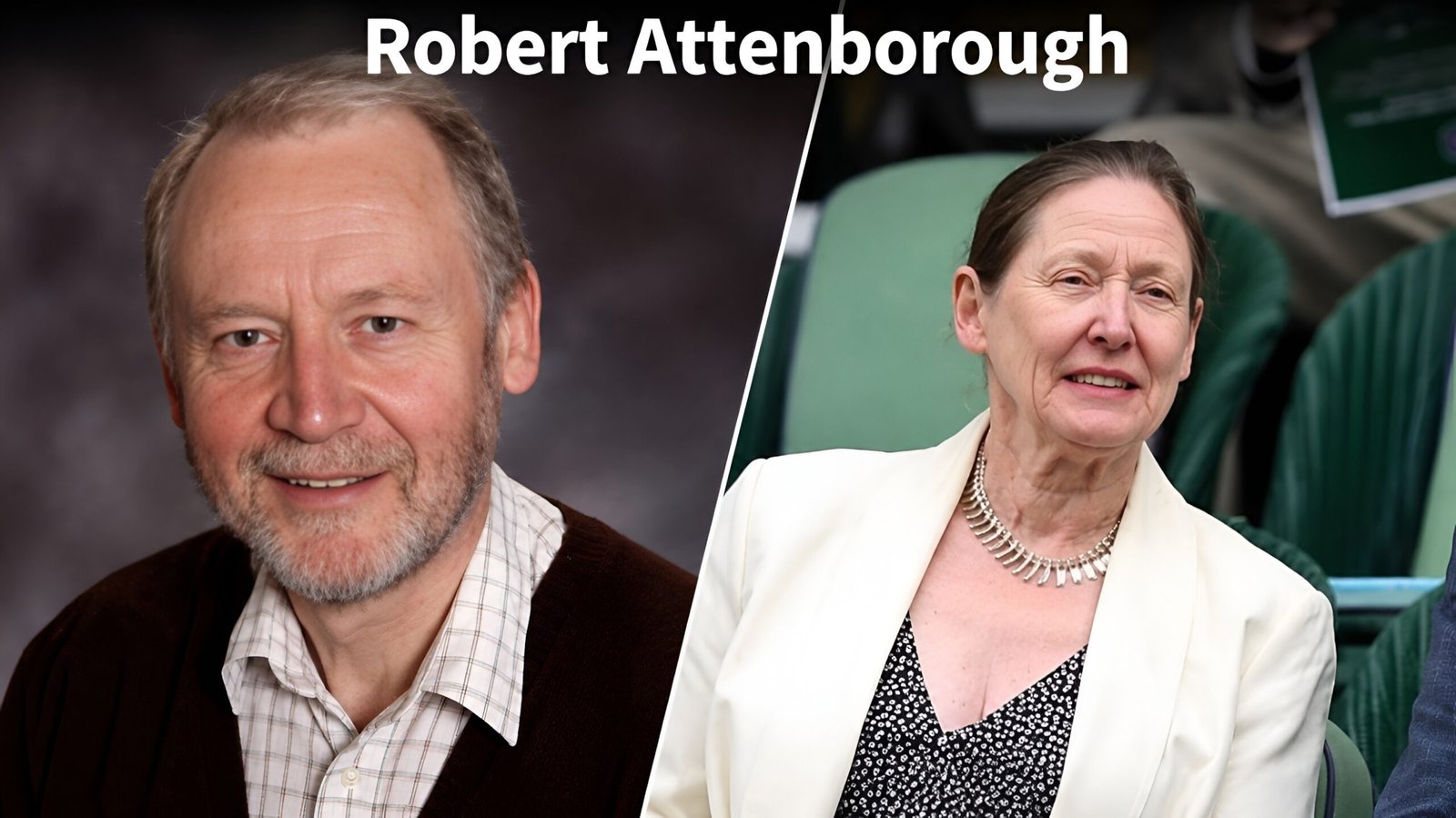
Robert Attenborough is a British biological anthropologist and the son of legendary broadcaster Sir David Attenborough. Born in August 1951, he built a distinguished academic career at the Australian National University (ANU) and the University of Cambridge, specializing in human population biology, health, and evolutionary anthropology — particularly in Papua New Guinea. His sister, Susan Attenborough, is a former primary school headteacher who now supports her father full-time.
Quick Bio Table
| Detail | Robert Attenborough | Susan Attenborough |
| Full Name | Robert David Attenborough | Susan Jane Attenborough |
| Born | August 1951 | April 1954 |
| Age (2026) | 74 | 71–72 |
| Nationality | British | British |
| Parents | Sir David Attenborough & Jane Elizabeth Ebsworth Oriel | Same |
| Siblings | Susan Attenborough (sister) | Robert Attenborough (brother) |
| Career | Biological Anthropologist, Senior Fellow | Former Headteacher, Personal Assistant to David |
| Institutions | ANU Canberra, University of Cambridge | Primary schools in Surrey |
| Known For | New Guinea human population research | Caring for Sir David Attenborough |
| Company Role | Director, David Attenborough Productions Ltd | Director, David Attenborough Productions Ltd |
Who is Robert Attenborough?
Robert Attenborough is a name that carries the weight of one of Britain’s most celebrated families, yet the man himself has spent a lifetime quietly building his own legacy far from the television screens that made his father famous. Born in August 1951 as the son of Sir David Attenborough and Jane Elizabeth Ebsworth Oriel, Robert chose the world of academia over the world of broadcasting. At 74 years of age, he stands as a respected biological anthropologist whose contributions to the understanding of human evolution and population health have shaped academic curricula on two continents.
Growing up in the Attenborough household meant being surrounded by intellectual curiosity, scientific wonder, and a family ethic of deliberate privacy. While Sir David was frequently absent — travelling the globe filming documentaries that would inspire millions — the children Robert and Susan developed a strong sense of independence and quiet determination. Their childhood instilled values that would guide both siblings toward purposeful yet low-profile careers. Neither sought fame, and neither needed it; both proved that the Attenborough name is about substance, not celebrity.
The Early Life and Academic Foundations of a Scholar
Robert Attenborough’s childhood unfolded within a household that valued intellectual achievement above public recognition. His father’s career meant long absences, which David Attenborough himself later reflected upon with regret, telling the Radio Times in 2017 that being away for three months at a time during his children’s formative years was something he deeply wished he could have managed differently. Despite this, Robert and his sister Susan were raised with warmth and a deep appreciation for learning, science, and careful observation of the world.
From his school years onward, Robert showed a strong inclination toward biology and human sciences. Unlike many children of famous parents who gravitate toward the arts or media, he was drawn to research — specifically the question of how human bodies and populations adapt to their environments over time. This intellectual curiosity steered him toward higher education in anthropology and biological sciences, equipping him with expertise in statistics, ecology, evolutionary theory, and human health. His foundational training set the stage for a career that, while quiet in public terms, has been deeply impactful in scholarly circles.
Robert Attenborough’s Career at Australian National University
One of the most significant chapters in Robert Attenborough’s professional life is his long association with the Australian National University (ANU) in Canberra. He served as a senior lecturer in bioanthropology within the School of Archaeology and Anthropology, a role that placed him at the heart of one of Australia’s most respected social science faculties. A report from the Canberra Times noted Sir David visiting the city specifically to see “his son Dr Robert Attenborough,” then a senior lecturer at ANU — a rare glimpse into the father-son bond that underlies both men’s dedication to science.
At ANU, Robert did not simply teach existing syllabi — he fundamentally reshaped the academic landscape of biological anthropology within the institution. In 1981, he took responsibility for the Human Variation course. In 1982, he introduced two entirely new subjects: Human Physiology and the Environment, and Biological Perspectives on Human Social Behaviour. He also helped create the Honours School in Biological Anthropology, approved in 1981 and implemented from 1982. These were foundation-level contributions that defined how an entire generation of students approached the intersection of biology, culture, and human adaptation.
Research Expertise: Human Population Biology and Papua New Guinea
The core of Robert Attenborough’s scholarly identity lies in his research into human population biology, with a particularly deep focus on Papua New Guinea and the broader Pacific region. His work examines how environmental factors, nutrition, disease exposure, and social structures shape the biological development and long-term health of human populations. Papua New Guinea, with its extraordinarily diverse genetic heritage and unique ecology, offers a remarkable natural laboratory for such inquiry, and Robert has been one of the leading voices in making sense of its complex human health landscape.
His published research spans topics including malaria adaptation, health and nutritional changes in Papua New Guinea communities, demographic shifts, and deep genetic histories of New Guinea populations. According to ResearchGate, his scholarly output includes 21 co-authored publications with an h-index of 6, representing meaningful scientific influence in a highly specialized field. His most recent research has focused on “health, nutrition and demography in Papua New Guinea,” according to the ANU Reporter — work that carries genuine implications for global health policy and our understanding of human evolutionary biology.
Cambridge University and the McDonald Institute Fellowship
Beyond Australia, Robert Attenborough has maintained strong ties to the United Kingdom’s academic community. He holds the position of Senior Fellow at the McDonald Institute for Archaeological Research at the University of Cambridge — one of the most prestigious centres for archaeological and anthropological research in the world. This dual institutional affiliation reflects the breadth of his expertise and the respect he commands across different research traditions, from field-based population health studies to more theoretically oriented evolutionary anthropology.
The McDonald Institute appointment places him alongside scholars working at the cutting edge of archaeological science, genetic anthropology, and human evolutionary studies. His research expertise, formally listed as covering “Human Population Biology and Health” alongside “Human Evolutionary and Behavioural Ecology,” bridges the gap between biological science and the social sciences. The fact that he remains available for consultancy work underscores that his knowledge carries practical value beyond academic publishing — it can inform real-world health planning and policy decisions for communities in the Pacific and beyond.
The Private Personal Life of a Public-Adjacent Figure
Despite belonging to one of Britain’s most recognisable families, Robert Attenborough has guarded his personal life with remarkable consistency. Public records confirm very little about his domestic arrangements, relationships, or family beyond what is officially documented. Companies House records identify him as British, born August 1951, and serving as a director of David Attenborough (Productions) Limited since 18 February 1997 — a business role that links him formally to his father’s professional operations. But details about a spouse, children, or grandchildren remain entirely outside the public domain.
This deliberate privacy is not unusual in the Attenborough family culture. Both Robert and his sister Susan appear to have made a conscious, lifelong choice to keep their personal affairs away from media scrutiny — a remarkable decision given the intense public interest in Sir David Attenborough. What makes Robert particularly intriguing to many readers is precisely this combination: a man connected to global fame, yet known almost exclusively through his academic achievements. His identity is that of a researcher, teacher, and scholar — not a celebrity family member — and that distinction has only grown more meaningful over time.
The Attenborough Family Legacy: Science Across Generations
The Attenborough family represents one of Britain’s most extraordinary contributions to science, culture, and public life. Sir David Attenborough became the voice of the natural world; his late brother, Sir Richard Attenborough, was an Oscar-winning filmmaker and director of Gandhi; and now Robert Attenborough carries the family’s scientific tradition into the realm of biological anthropology. The generational thread running through this family is not fame itself, but an unwavering commitment to understanding the world — whether through a camera lens, a stage, or a research field in Papua New Guinea.
Robert’s relationship with his father has been publicly warm, if rarely discussed. Sir David gifted Robert a pet salamander for his birthday when he was young — a memory David later recounted with visible delight, describing how the animal gave birth shortly after arrival, leaving both father and son wide-eyed with wonder. That small story reveals much about how the Attenborough household functioned: science was not merely professional, it was woven into everyday family life. Robert’s choice of a career in human evolutionary biology feels less like a departure from his father’s path and more like a continuation of the same essential curiosity, turned inward toward the human species itself.
Academic Contributions and Curriculum Building
One of the less-discussed but most significant aspects of Robert Attenborough’s career is his role as a curriculum builder in a time when biological anthropology was still finding its academic footing in Australia. His ANU chapter makes clear that he worked within a very small academic stream, initially alongside just one or two core colleagues, carrying the weight of teaching, honours supervision, and disciplinary development simultaneously. This kind of foundational work — less glamorous than publishing high-cited papers, but equally important — shaped the discipline for decades.
He helped build an Honours School, designed and taught multiple new courses, and supervised thesis students across a range of biological anthropology topics. His pressing for expanded staffing in areas such as human genetics and skeletal biology showed institutional foresight. These contributions speak to a scholar who understood that building the field — not just contributing to it — was a form of academic leadership. For students who passed through ANU’s anthropology programme in the 1980s and 1990s, Robert Attenborough’s influence would have been formative, even if his name remains largely unknown outside specialist circles.
The Bond Between Robert and Susan: Siblings in the Shadow of Greatness
Robert Attenborough and his sister Susan share more than a famous surname. They share a family philosophy centred on privacy, purposeful work, and quiet support for one another and for their father. Both became directors of David Attenborough (Productions) Limited — a formal expression of their involvement in Sir David’s professional legacy. Both have chosen careers defined by service and expertise rather than by public recognition. And both have, in different ways, supported their father through the years following the death of their mother, Jane Elizabeth Ebsworth Oriel, in 1997.
While Robert pursued his academic career across Australia and the UK, Susan remained closer to home, eventually stepping into a caregiving and managerial role for Sir David that her mother had previously occupied. The sibling dynamic reflects a family that distributes its responsibilities thoughtfully, with each person contributing according to their strengths. Robert brings intellectual credibility and scientific accomplishment. Susan brings personal loyalty and practical daily support. Together, they represent the private, human side of a family whose public face — Sir David Attenborough — has been one of the most beloved in British history.
Robert Attenborough and the Connection to His Famous Uncle Richard
The Attenborough family story gains further richness when one considers that Robert’s uncle was Sir Richard Attenborough — the celebrated actor and director who won two Academy Awards for Gandhi in 1983. Sir Richard was Sir David’s older brother, making him Robert’s uncle. Despite growing up with such extraordinary public figures as both father and uncle, Robert chose a path entirely removed from film, television, or performance. This choice speaks to a deeply rooted preference for scholarly life over cultural celebrity — a preference that appears to run through his character as consistently as the scientific curiosity he shares with his father.
Sir Richard Attenborough passed away in August 2014, leaving behind a towering legacy in British cinema. His son Michael Attenborough became a respected theatre director, while his daughter Charlotte became an actress. Even within the extended Attenborough family, the tendency to pursue meaningful, skilled careers across creative and intellectual domains is striking. Robert fits naturally into this broader picture: a member of a family where excellence in one’s chosen field is simply expected, and where public fame is neither the measure nor the goal of a life well lived.
Robert Attenborough’s Net Worth and Financial Standing
Questions about Robert Attenborough’s net worth circulate online, driven largely by curiosity about what life looks like for the son of a globally famous and financially successful broadcaster. The honest answer is that Robert’s financial standing has never been publicly disclosed, and any specific figures quoted by third-party websites should be treated with caution. What is verifiable is that a career as a senior academic lecturer in Australia and a Fellow at Cambridge, combined with his directorial role in David Attenborough (Productions) Limited, would represent a comfortable but not extravagant financial profile by any objective measure.
His wealth, whatever its precise level, has never appeared to influence his choice of career or lifestyle. He has not pursued commercial opportunities, media appearances, or the kind of brand associations that might monetize his famous surname. This consistency reinforces the impression of a man for whom intellectual integrity and academic contribution represent the primary measures of success. In a culture increasingly obsessed with net worth as a proxy for achievement, Robert Attenborough’s career offers a quiet but pointed counterexample: deep expertise, genuine contribution to human knowledge, and a life lived on one’s own terms are their own form of wealth.
Who is Susan Attenborough?
Susan Jane Attenborough, born in April 1954, is the younger sibling of Robert Attenborough and the daughter of Sir David Attenborough. Now 71 years old, Susan spent the majority of her working life as a dedicated educator, serving as headteacher of a primary school in Surrey — a role that placed her at the centre of children’s development and community life. Like her brother, she has consistently chosen a life outside the public spotlight, maintaining a dignified privacy that reflects the family’s shared values. Yet her role in the Attenborough story is anything but minor.
Following the death of her mother Jane in 1997, Susan stepped into a role of increasing personal and professional significance for her father. She began working closely with Sir David Attenborough, taking on responsibilities that her mother had previously managed — from personal logistics and daily support to involvement in the family’s production company. Sir David has publicly described her as a “wonderful daughter,” and has credited her with helping manage everyday tasks including shopping and cooking. This transition from school headteacher to her father’s primary support person reflects a woman of remarkable adaptability, loyalty, and quiet strength.
Susan Attenborough’s Career in Education and Community Leadership
Before becoming known as Sir David’s indispensable companion and support, Susan Attenborough built a professional career that stood entirely on its own merits. As headteacher of a primary school in Surrey, she held a position that demands exceptional leadership, emotional intelligence, and a deep commitment to the wellbeing of children and families. School headship in the UK is not a role for the faint-hearted — it involves managing staff, navigating government policy, communicating with parents, and maintaining an environment where children can genuinely flourish.
Susan’s work in education reflects the same values instilled throughout her upbringing: intellectual rigour, personal responsibility, and service to the community. Those who knew her in professional contexts have described a woman of calm authority and genuine care. Her transition from school leadership to supporting her father represents not a diminishment but an evolution — trading one form of quiet, essential service for another. The through-line in Susan Attenborough’s life is not fame or ambition but a consistent dedication to the people in her care, whether those are schoolchildren in Surrey or the world’s most beloved naturalist.
Susan Attenborough’s Role in Her Father’s Later Years
In the years after her mother’s passing and particularly as Sir David Attenborough has grown older, Susan Attenborough has become an essential presence in his daily life. In a 2009 interview, Sir David described Susan visiting him regularly — helping with shopping, cooking shepherd’s pies, and generally maintaining the household routines that support his extraordinary continued output as a broadcaster and conservationist. This role, which David affectionately described as Susan coming to “muck him out,” is both deeply personal and practically significant.
Susan also holds a formal role within David Attenborough (Productions) Limited, the family company through which Sir David’s professional work is managed. This places her at the intersection of the personal and the professional — not merely a devoted daughter, but an active participant in managing the legacy of one of Britain’s greatest living public figures. The connection between Robert Attenborough’s directorial role in the same company and Susan’s role creates a picture of a family that operates with quiet coordination, sharing responsibility for one another and for the broader legacy they collectively steward.
The Relationship Between Robert and Susan: A Shared Legacy
The story of Robert Attenborough and Susan Attenborough is ultimately a story about the less-visible dimensions of extraordinary families. Behind every public figure of Sir David Attenborough’s stature, there are private individuals who provide the stability, care, and continuity that make sustained achievement possible. Robert and Susan represent that quiet infrastructure — not passive recipients of their father’s fame, but active contributors to a family legacy that encompasses science, education, conservation, and human compassion.
Their shared values — privacy, intellectual depth, service over self-promotion — reflect both their upbringing and their own considered choices as adults. Robert chose the rigour of biological anthropology; Susan chose the service of education and family care. Neither path is glamorous by conventional measures. Both paths are deeply meaningful. Together, Robert and Susan Attenborough demonstrate that the Attenborough family’s contribution to the world extends well beyond what any television screen can capture — into laboratories in Papua New Guinea, classrooms in Surrey, and the quiet daily rhythms of a family that loves, works, and endures together.
Conclusion
Robert Attenborough is far more than David Attenborough’s son. He is a distinguished biological anthropologist who spent decades advancing our understanding of human population biology, building academic programmes, conducting fieldwork in Papua New Guinea, and contributing to the scholarship of two of the world’s leading research universities. His sister, Susan Attenborough, built her own legacy in British education before becoming the cornerstone of her father’s personal and professional life in his later years. Together, these two siblings embody a family tradition of purposeful work, intellectual integrity, and deliberate privacy that stands in quiet but powerful contrast to the celebrity culture that surrounds their famous name. The Attenborough legacy is not one person’s story — it belongs to all of them.
Frequently Asked Questions (FAQs)
Q1. Who is Robert Attenborough?
Robert Attenborough is a British biological anthropologist, son of Sir David Attenborough, and former senior lecturer at the Australian National University. He is a Senior Fellow at Cambridge’s McDonald Institute and specialises in human population biology, particularly in Papua New Guinea.
Q2. How old is Robert Attenborough?
Robert Attenborough was born in August 1951, making him 74 years old as of 2026.
Q3. What is Robert Attenborough’s relationship to David Attenborough?
Robert Attenborough is Sir David Attenborough’s son, born to David and his late wife Jane Elizabeth Ebsworth Oriel, who married in 1950.
Q4. Who is Susan Attenborough?
Susan Attenborough is Robert’s younger sister and Sir David Attenborough’s daughter, born in April 1954. She is a former primary school headteacher who now works closely with and cares for her father.
Q5. Does Robert Attenborough have a Wikipedia page?
No verified, comprehensive Wikipedia page for Robert Attenborough exists. Information about him is documented through ANU academic records, Cambridge University listings, and Companies House records.
Q6. What is Robert Attenborough’s net worth?
Robert Attenborough’s net worth has never been publicly disclosed. He has built a career in academia, and specific financial figures circulated online remain unverified.
Q7. What does Susan Attenborough do for Sir David Attenborough?
Susan Attenborough supports her father in daily life and professional matters. She helps with shopping, household management, and holds a directorial role in David Attenborough (Productions) Limited, the family’s production company.
Fore more info: Novainsights.co.uk
