
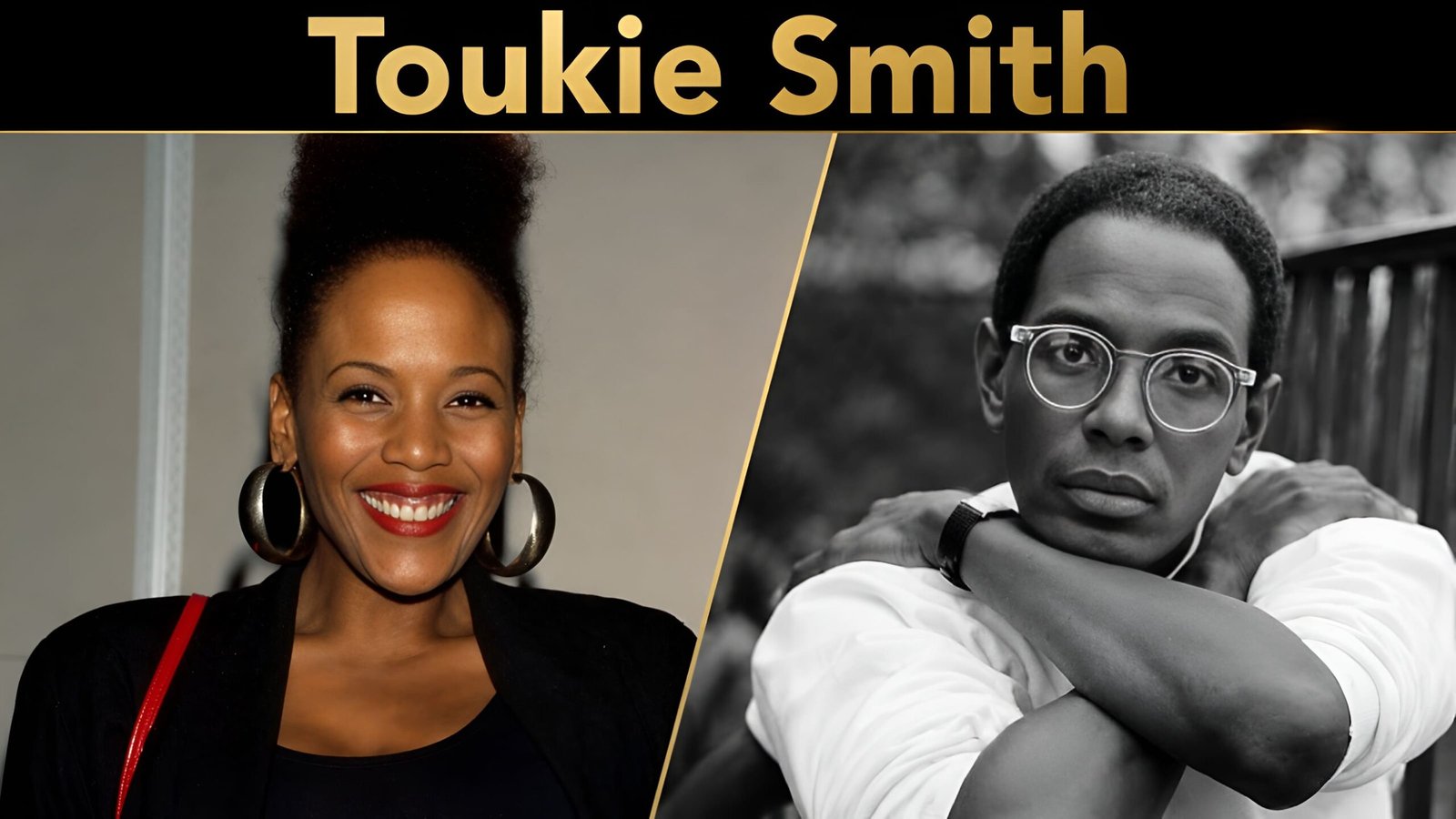
Toukie Smith, born Doris A. Smith on April 25, 1955, in Philadelphia, Pennsylvania, is an American model and actress best known for her role as Eva Rawley on the NBC sitcom 227 and her appearances on Miami Vice. She is also widely recognized as the sister of legendary fashion designer Willi Smith and for her long-term relationship with Oscar-winning actor Robert De Niro.
Quick Bio Table
| Detail | Information |
| Full Name | Doris A. Smith |
| Stage Name | Toukie Smith |
| Date of Birth | April 25, 1955 |
| Birthplace | Philadelphia, Pennsylvania, USA |
| Profession | Actress, Model |
| Notable TV Role | Eva Rawley in 227 (NBC) |
| Known For | Miami Vice, The Preacher’s Wife, Joe’s Apartment |
| Fashion Clients | Chanel, Versace, Thierry Mugler, Geoffrey Beene |
| Magazine Covers | Vogue, Elle, Ebony, Cosmopolitan, Redbook |
| Notable Relationship | Robert De Niro (1988–1996) |
| Children | Twin sons Aaron Kendrick and Julian Henry (born 1995) |
| Brother | Willi Smith (fashion designer, 1948–1987) |
| Net Worth | Approximately $3 million |
| Education | Fashion Institute of Technology, New York City |
Who is Toukie Smith?
Toukie Smith is one of the most quietly remarkable women in American entertainment and fashion history. Born Doris A. Smith in Philadelphia, Pennsylvania, she rose from a working-class background to become a celebrated runway model, magazine cover star, and television actress during the 1970s, 80s, and 90s. Despite never seeking the spotlight as aggressively as many of her contemporaries, her impact on the industry — particularly for African American women — has been deep and lasting.
Her story is inseparable from the world she grew up in. Philadelphia in the 1950s was a city of strong communities, working families, and cultural pride. Toukie and her brother Willi grew up in a household where, as Willi once famously recalled, there were “more clothes than food,” a reflection of a family that valued style, presentation, and creative expression even under tight financial constraints. That shared love of fashion became the foundation of two extraordinary careers.
Early Life and the Road to New York City
Growing up in Philadelphia, Toukie Smith showed early signs of the poise and confidence that would later define her modeling career. After completing her early education, she made the bold decision to move to New York City and enroll at the prestigious Fashion Institute of Technology. This move was pivotal — it placed her at the very center of the American fashion world at a time when the industry was beginning to open its doors, however slowly, to Black women.
New York in the early 1970s was electric with creative energy. The fashion industry was evolving rapidly, and Toukie arrived with striking features, natural confidence, and an instinct for the camera that immediately caught the attention of designers and photographers. Her journey from student to sought-after model was not overnight, but her persistence and raw talent ensured that doors that had been closed to many women like her began to swing open.
Toukie Smith’s Modeling Career: Vogue, Versace, and Groundbreaking Recognition
Toukie Smith’s modeling career officially launched in the early 1970s and quickly gathered impressive momentum. She worked with some of the most prestigious names in global fashion, including Chanel, Versace, Thierry Mugler, Geoffrey Beene, Norma Kamali, Patrick Kelly, and Issey Miyake. Her presence on the runway was commanding, and her ability to embody the vision of multiple designers across very different aesthetics spoke to her exceptional versatility as a model.
Her print career was equally distinguished. She graced the pages of Vogue, Elle, Ebony, Cosmopolitan, Redbook, and Seventeen — publications that defined mainstream beauty standards in America. In 1978, Bloomingdale’s named her their Model of the Year, one of the most coveted commercial honors in American retail fashion. That same year, she achieved a milestone rarely discussed but deeply significant: she became one of the first African American models to have a mannequin created in her likeness, a concrete symbol of how far representation in fashion had come — and how much she personally had contributed to it.
Breaking Barriers: Race, Representation, and the Fashion Industry
The fashion industry in the 1970s was largely dominated by white faces and European standards of beauty. Toukie Smith, alongside a small number of trailblazing Black models, helped to challenge and redefine those standards. Her consistent presence in major fashion campaigns and editorial spreads forced the industry to acknowledge that beauty was not monolithic — that elegance, style, and market value came in all shades.
She modeled for her late brother Willi’s clothing line as well, bringing a personal dimension to her professional work. The relationship between a model’s influence and a designer’s vision was rarely as close as it was between these two siblings, and their collaboration — even informally — produced some of the most culturally resonant imagery of Black fashion in that era. Toukie’s legacy in this regard goes beyond personal achievement; it is part of the broader story of how Black Americans reclaimed space in industries that had long excluded them.
Transition to Acting: Miami Vice and the Screen Debut
In the late 1980s, Toukie Smith made the transition from modeling to acting — a move that many models attempt but few execute with genuine success. Her acting debut came when she landed a role as Angie, assistant and confidante to Caitlin Davies, in multiple episodes of the iconic television series Miami Vice in 1987. The show was one of the most stylistically influential programs in television history, and appearing in it gave Toukie immediate credibility in the entertainment world.
Her screen presence translated naturally from the runway. The same qualities that made her an exceptional model — composure, physicality, and the ability to hold an audience’s attention without effort — served her well as an actress. Her appearance in Miami Vice opened further doors and signaled that Toukie Smith was not merely a model trying her hand at acting, but a performer with genuine range and the discipline to develop new skills.
Eva Rawley in 227: Toukie’s Defining Television Role
Without question, Toukie Smith’s most recognized acting role came when she joined the cast of the NBC sitcom 227 as Eva Rawley. The show, which ran from 1985 to 1990, was a groundbreaking piece of American television — a Black sitcom set in a Washington D.C. apartment building that explored everyday life, relationships, and community with warmth and humor. Toukie joined the cast in 1989 and remained through the show’s final season in 1990.
As Eva Rawley, a vibrant artist and building manager, Toukie brought a combination of wit, sophistication, and warmth that resonated strongly with audiences. Her performance deepened the show’s already rich ensemble and gave her the kind of sustained television exposure that cemented her status as a genuine actress rather than a celebrity cameo. 227 was significant not just for Toukie’s career, but for American culture broadly — it was one of the first primetime network shows to center entirely on Black middle-class life.
Film Career: From Joe’s Apartment to The Preacher’s Wife
Beyond television, Toukie Smith built a respectable film resume throughout the 1990s. Her screen credits include Me and Him (with Bill Raymond), Talkin’ Dirty After Dark (1991), I Like It Like That (with Lisa Vidal), Joe’s Apartment (1996), The Preacher’s Wife (1996, starring Denzel Washington and Whitney Houston), and Goosed. Each of these films showcased a different facet of her talent, from comedy to drama.
The Preacher’s Wife in particular stands as one of the more notable entries in her filmography, given the film’s cultural significance and the caliber of its cast. Appearing alongside Whitney Houston and Denzel Washington placed Toukie in the company of the biggest stars of her generation, a testament to the respect she had earned within the industry. Her film work, though never as high-profile as her television career, demonstrated a consistency and professionalism that defined her entire professional life.
Robert De Niro: The Relationship That Captured America’s Attention
Among all the chapters of Toukie Smith’s personal life, none attracted more public attention than her long-term relationship with acclaimed actor Robert De Niro. The two were together from approximately 1988 to 1996 — nearly a decade — and though they never married, their relationship was one of Hollywood’s most talked-about romances. De Niro, already an Oscar-winning legend by the time they met, had a reputation for keeping his personal life private, making his relationship with Toukie all the more intriguing to the press and public.
The relationship produced perhaps its most remarkable chapter in 1995, when Toukie gave birth to twin sons — Aaron Kendrick De Niro and Julian Henry De Niro. The twins were conceived through in vitro fertilization and carried by a surrogate mother, a fact that was widely reported at the time. Though the relationship eventually ended, both Toukie and Robert have maintained a respectful co-parenting relationship, and the twins represent perhaps the most enduring bond between two people whose connection once defined an era of celebrity culture.
Life After the Spotlight: Privacy, Advocacy, and Legacy
In the years following her most active period in entertainment, Toukie Smith made a deliberate and well-documented choice to step back from the public eye. Unlike many celebrities who struggle with the transition away from fame, Toukie approached her quieter years with intention and grace. She has remained largely absent from social media — a decision that speaks to a broader philosophy about privacy and the ownership of one’s own narrative.
She has, however, continued to engage with causes close to her heart. Toukie is known to be passionate about animal rights and has been involved in charitable efforts supporting animal welfare. She has also been associated with initiatives promoting diversity and empowerment for women and minorities in the arts and business sectors. These activities — low-profile by design — reveal a woman whose values and sense of purpose have always extended beyond the camera.
Toukie Smith’s Enduring Impact on Black Fashion and Culture
It is impossible to fully appreciate Toukie Smith’s place in American cultural history without understanding the context in which she built her career. She entered the modeling world at a moment when Black women were still fighting for basic visibility in mainstream fashion. By the time she left the runway, she had not only achieved personal success but had helped shift the entire industry’s understanding of what was marketable, beautiful, and commercially viable.
Her mannequin milestone, her Bloomingdale’s Model of the Year award, her covers in the most widely read fashion magazines in America — each of these achievements carried weight beyond personal accomplishment. They were data points in the ongoing argument that Black women deserved full representation in fashion and entertainment, an argument that the next generation of models and actresses would carry forward largely because women like Toukie had already done the foundational work.
Who is Willi Smith? The Fashion Legend Who Shaped a Generation
Willi Donnell Smith was born on February 29, 1948, in Philadelphia, Pennsylvania — the same city that produced his sister Toukie. From an early age, he demonstrated a startling natural gift for design and a deep understanding of how clothing connected to identity and culture. He studied fashion illustration at the Philadelphia College of Art before earning admission to the prestigious Parsons School of Design in New York City, where his talent was quickly recognized.
His career trajectory was remarkable. By 1969, his name appeared on clothing labels for Digits, a sportswear company, before he had even turned 22. In 1976, alongside business partner Laurie Mallet, he founded WilliWear Ltd. — a company that would go on to gross over $25 million in annual sales by 1986. He won the coveted Coty American Fashion Critics’ Award for Women’s Fashion in 1983 and was the youngest designer ever nominated for that honor in 1971. He designed wedding attire for Edwin Schlossberg’s marriage to Caroline Kennedy in 1986 and even created Mary Jane Watson’s wedding dress in the Spider-Man comic strip in 1987.
Willi Smith died tragically on April 17, 1987, at just 39 years old, after contracting pneumonia and a parasitic disease during a fabric-buying trip to India. A subsequent autopsy revealed he was HIV-positive, making his death AIDS-related. His passing was a devastating loss for the fashion world. In 2002, he was posthumously honored with a bronze plaque on the Fashion Walk of Fame. His philosophy — “I don’t design clothes for the Queen, but for the people who wave at her as she goes by” — remains one of fashion’s most quoted and most democratic ideas.
The Bond Between Toukie and Willi: Siblings Who Defined an Era
The connection between Toukie Smith and Willi Smith goes far beyond shared DNA. They were creative allies, mutual inspirations, and two expressions of the same Philadelphia spirit that believed style was not a privilege but a right. Willi’s success in fashion encouraged Toukie to pursue her own path in the same world, and Toukie modeled for her brother’s line, giving WilliWear a human face that was deeply personal and powerfully symbolic.
Willi’s death in 1987 was a wound that never fully healed. Toukie has spoken rarely but movingly about losing her brother, and those who knew her in the years following his passing described her grief as profound and private. The timing was particularly cruel — Willi died just as Toukie was transitioning into her acting career, meaning she navigated the biggest professional shift of her life while carrying an enormous personal loss. That she did so with the grace and dignity that had always defined her speaks volumes about her character.
Conclusion
Toukie Smith is far more than a footnote in the story of American entertainment. She is a woman who, across several decades and multiple industries, demonstrated that grace, discipline, and authentic talent have a power that no trend can diminish. From the runways of New York to the television screens of millions of American households, from a defining relationship with one of Hollywood’s greatest actors to the quiet, purposeful life she has chosen in more recent years, Toukie has always moved on her own terms.
Her connection to Willi Smith deepens her story immeasurably. Together, the Smith siblings represent something rare and beautiful — a shared vision, born in Philadelphia, that said Black creativity deserves the biggest stages in the world. Both earned those stages. Both left marks that will not fade. And in understanding one, we inevitably come to better understand the other.
Frequently Asked Questions (FAQs)
Q1: What is Toukie Smith’s real name?
Her real name is Doris A. Smith. She adopted the stage name “Toukie” professionally and it has been her public identity for decades.
Q2: What is Toukie Smith best known for?
She is best known for playing Eva Rawley on the NBC sitcom 227 and for her long-term relationship with actor Robert De Niro, with whom she has twin sons.
Q3: Did Toukie Smith and Robert De Niro get married?
No. They were in a relationship from approximately 1988 to 1996 but never officially married. They share twin sons, Aaron Kendrick and Julian Henry, born in 1995 via surrogacy.
Q4: Who was Willi Smith?
Willi Smith was Toukie’s younger brother and one of the most celebrated African American fashion designers in American history. He founded WilliWear Ltd. in 1976 and died in 1987 at age 39.
Q5: What was Toukie Smith’s most significant modeling achievement?
She was named Bloomingdale’s Model of the Year in 1978 and became one of the first African American models to have a mannequin created in her likeness — a historic milestone for representation in fashion.
Q6: Is Toukie Smith still active in entertainment?
She has largely stepped back from public life and entertainment, choosing privacy. She has been involved in animal rights advocacy and diversity initiatives, but is not currently active in film or television.
Q7: How did Willi Smith’s death affect Toukie Smith’s career?
Willi died in April 1987, just as Toukie was transitioning from modeling into acting. She navigated this major professional shift while grieving a profound personal loss, which she has spoken about with characteristic dignity and restraint.
Fore more info: Novainsights.co.uk
