
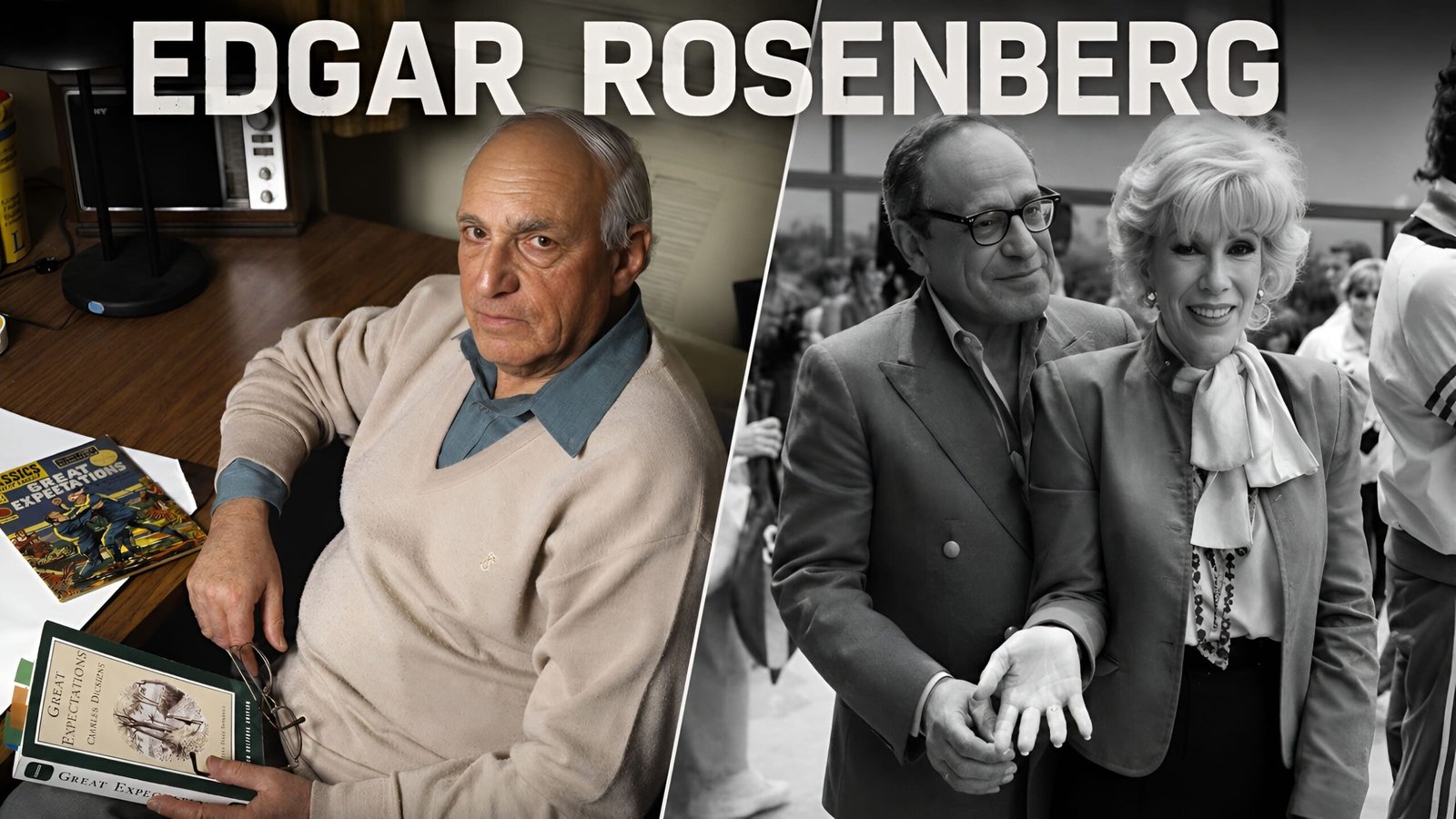
Edgar Rosenberg was a German-born British film and television producer, best known as the husband, manager, and creative partner of legendary comedian Joan Rivers. Born on September 21, 1925, in Bremerhaven, Germany, he built a respected career in Hollywood before his tragic death by suicide on August 14, 1987, in Philadelphia, Pennsylvania, aged 61.
Quick Bio Table
| Detail | Information |
| Full Name | Edgar Alfred Rosenberg |
| Born | September 21, 1925, Bremerhaven, Germany |
| Died | August 14, 1987, Philadelphia, Pennsylvania |
| Age at Death | 61 |
| Nationality | German-born British |
| Education | Rugby School; Cambridge University |
| Occupation | Film & Television Producer, Writer |
| Spouse | Joan Rivers (m. July 1965) |
| Children | Melissa Rivers (born 1968) |
| Notable Works | Rabbit Test (1978), The Poppy Is Also a Flower (1966), The Late Show Starring Joan Rivers |
| Years Active | 1964–1987 |
Who Was Edgar Rosenberg?
Edgar Rosenberg was far more than a footnote in Hollywood history. He was a serious, disciplined producer and behind-the-scenes architect who helped shape some of the most important moments in American television during the 1960s, 1970s, and 1980s. Born to Jewish parents in Bremerhaven, Germany, in 1925, he lived a life defined by survival, reinvention, and unwavering dedication to both his craft and his family. His story is one that deserves to be told on its own terms — not simply as a supporting chapter in someone else’s biography.
Though his name rarely appeared in the spotlight, Rosenberg’s fingerprints were all over the entertainment landscape of his era. He understood the mechanics of television production with rare precision, earning respect from colleagues and networks alike. People who worked alongside him described him as meticulous, calm under pressure, and deeply loyal — qualities that defined his career from his early NBC days all the way to his final producing credit. His life was shaped by remarkable resilience, extraordinary talent, and ultimately, profound personal pain.
From Nazi Germany to Cambridge University: A Remarkable Early Life
Edgar Rosenberg’s early years read like something out of a historical novel. Born in 1925 to Jewish parents in Bremerhaven, Germany, his family was forced to flee the rising tide of Nazi persecution when he was still a young boy. They escaped first to Denmark, then made their way south to South Africa — a journey that reflected the desperation and danger facing Jewish families across Europe in the 1930s. That experience of displacement and survival would shape his character for the rest of his life.
Despite the upheaval of his childhood, Rosenberg eventually received a world-class education. He attended the prestigious Rugby School in England and went on to study at Cambridge University — institutions that cultivated his intellectual sharpness and instilled a sense of discipline that served him throughout his career. His ability to move between cultures, languages, and social environments with ease was a direct product of this extraordinary upbringing. By the time he arrived in the United States as a young man, he carried with him the resilience of a survivor and the polish of a Cambridge scholar.
Early Career in America: From NBC Assistant to Independent Producer
When Rosenberg arrived in the United States, he wasted no time making his mark. He secured a prestigious position at NBC, rising to become an assistant to Emanuel Sacks, who served as the network’s vice president of entertainment. This role placed him at the very heart of American broadcasting during one of its most formative periods, and it gave him an education in television production that no university could have matched. However, a serious traffic accident that required a long recovery period cost him that position, a setback that temporarily reduced him to working as a night clerk at a bookstore.
Rather than letting that setback define him, Rosenberg adapted. He moved into public relations, working for the firm run by Anna M. Rosenberg — to whom he was not related — where he became a trusted and valued source for journalists covering the entertainment industry. He also became a co-founder of the Telsun Foundation, a nonprofit production company affiliated with the United Nations, where he helped develop a series of television films designed to promote international understanding. These early career experiences revealed a man of genuine intellectual curiosity, professional tenacity, and a belief that media could serve a larger social purpose.
The Telsun Foundation and The Poppy Is Also a Flower: Prestige Production
One of the early highlights of Edgar Rosenberg’s producing career was his involvement with The Poppy Is Also a Flower, a 1966 television film produced under the banner of the Telsun Foundation and endorsed by the United Nations. The film, which addressed the global opium trade, starred an extraordinary ensemble cast including Yul Brynner, Angie Dickinson, Trevor Howard, and Eli Wallach. It was later released theatrically and represented serious, socially conscious filmmaking — a far cry from lightweight entertainment fare.
This project demonstrated that Rosenberg was not simply chasing commercial success. He was interested in content that had weight, relevance, and international significance. His work with the Telsun Foundation positioned him as a producer willing to tackle difficult subjects through the medium of film and television. The Poppy Is Also a Flower remains a testament to what early television production could achieve when driven by creative ambition and a commitment to meaningful storytelling. It earned him lasting respect in the industry and helped establish his reputation as a producer of substance.
How Edgar Rosenberg Met Joan Rivers: A Romance That Changed Everything
The most pivotal moment of Edgar Rosenberg’s personal and professional life came in July 1965, when he met a sharp, ambitious young comedian named Joan Rivers. Rosenberg had hired her to work with him in Jamaica, where he was rewriting a screenplay for a joint movie deal he was developing with his close friend, legendary actor Peter Sellers. Within just four days of meeting her, the two were married — a whirlwind romance that surprised nearly everyone who knew them, given how different their personalities appeared on the surface.
Rosenberg was reserved, methodical, and private; Joan was explosive, loud, and hungry for the spotlight. Yet their differences turned out to be deeply complementary. He saw in her a comedic genius that deserved serious professional management, and she found in him a steady, strategic mind that could help navigate the often treacherous landscape of Hollywood. Their marriage was not just a personal union but a professional partnership from its very first days — one that would define both of their careers for the next two decades and leave a permanent mark on American entertainment history.
Edgar Rosenberg as Joan Rivers’ Manager: The Power Behind Her Stardom
From the earliest days of their marriage, Edgar Rosenberg took on the role of Joan Rivers‘ manager and primary career strategist. He was far more than a passive husband cheering from the sidelines — he was actively involved in shaping her public image, negotiating deals, and making the critical decisions that determined where her career would go. His British education and corporate experience at NBC gave him tools that few managers in the comedy world possessed, and he used them deliberately and effectively on Joan’s behalf.
Under his guidance, Joan Rivers’ career accelerated dramatically. He helped her secure television opportunities, guided her through the complex world of Las Vegas entertainment, and worked to position her as a legitimate force in late-night television at a time when women were largely absent from that space. In 1968, he produced her first daytime television show, The Joan Rivers Show, signaling his commitment to building her presence across multiple platforms. His managerial style was intense and detail-oriented, sometimes creating friction with network executives, but always focused on protecting and advancing Joan’s interests with fierce dedication.
Producing Rabbit Test (1978): A Bold Cinematic Gamble
In 1978, Edgar Rosenberg produced Rabbit Test, a feature film written and directed by Joan Rivers that starred a then-relatively unknown Billy Crystal in his first major film role. The premise — a man becomes the world’s first pregnant male — was unconventional and deliberately provocative, reflecting Joan’s irreverent comedic style. Rosenberg’s decision to back the project financially and logistically was a significant professional gamble, representing a full commitment to his wife’s creative vision at a time when female directors were extremely rare in Hollywood.
While the film received mixed reviews and was not a massive commercial success, it remains a fascinating cultural artifact of its era. More importantly, it demonstrated the depth of Edgar Rosenberg’s faith in Joan Rivers as a creative force. He was not simply managing a performer — he was investing in an artist he believed in completely. His willingness to take creative risks, even when they came with financial uncertainty, defined his approach to producing and reflected the genuine partnership at the heart of their marriage. Billy Crystal would later go on to massive fame, and Rabbit Test has endured as a notable chapter in both their careers.
The Fox Late Show Deal: Ambition, Conflict, and Professional Collapse
The decision that would ultimately unravel everything came in 1985, when Edgar Rosenberg and Joan Rivers accepted a deal with the fledgling Fox Broadcasting Company to host The Late Show Starring Joan Rivers. The offer was extraordinary — a three-year, $15 million contract that would make Joan the first woman to host a major late-night talk show. Rosenberg served as executive producer, and the show launched in October 1986 with enormous fanfare and genuine public excitement around what felt like a historic television moment.
However, the relationship between Rosenberg and Fox executives deteriorated rapidly. The network wanted Joan to soften her interview style and adopt a friendlier persona, while Rosenberg insisted on protecting the edgier, more confrontational approach that had made her famous. The creative disagreements were fierce and personal, and they ultimately cost Joan her job when Fox fired her in May 1987. What made the situation particularly painful was the widespread belief within the industry that the network would have retained Joan Rivers if she had been willing to remove Edgar as executive producer — a choice she was unwilling to make, and one that sealed the show’s fate.
The Final Months: Health Struggles and Personal Separation
The period following the cancellation of The Late Show was devastating for Edgar Rosenberg in ways that extended well beyond professional disappointment. He had been suffering from significant health problems in the months leading up to and following the show’s cancellation, and the combination of physical decline, professional failure, and public humiliation created a pressure that became increasingly unbearable. Reports from people close to both Edgar and Joan during this period describe a man who was deeply shaken, isolated, and struggling to find solid ground beneath him.
In the weeks before his death, Edgar and Joan had also separated — a development that added profound personal grief to an already overwhelming situation. The man who had spent more than two decades building his identity around being both the husband and professional partner of one of America’s most famous comedians suddenly found himself without that anchor. Those who knew him sensed his deterioration but were unable to intervene effectively. The weight of everything — the exile from Fox, the health decline, the marital separation — proved impossible to carry.
Edgar Rosenberg’s Death: A Tragedy That Shook Hollywood
On August 14, 1987, just three months after the cancellation of The Late Show, Edgar Rosenberg died by suicide in a Philadelphia hotel room, having overdosed on prescription drugs. He was 61 years old. The news sent shockwaves through the entertainment community, not only because of the tragedy itself but because of what it revealed about the immense personal toll that professional failure and public pressure can extract from those who live and work in the spotlight’s shadow.
Joan Rivers, who had already been devastated by the loss of her television career, was now confronted with a grief that was both public and profoundly private. She later spoke with remarkable candor about the complexity of her feelings — expressing both her enduring love for Edgar and a deep, raw anger at his choice to leave her and their daughter Melissa behind. In a 2010 interview, she described her husband’s death as something akin to Samson bringing down the temple — an act whose consequences extended far beyond the man himself. Her honesty about that grief became one of the most poignant threads in her subsequent public life.
Who Is Joan Rivers?
Joan Rivers — born Joan Alexandra Molinsky on June 8, 1933, in Brooklyn, New York — was one of the most influential comedians in American history. The daughter of Russian Jewish immigrants, she attended Barnard College before embarking on a career in comedy that would eventually redefine what women could do in the entertainment industry. Her big break came in 1965 on The Tonight Show Starring Johnny Carson, where her sharp, self-deprecating wit immediately captivated audiences and earned her a permanent place in American comedy culture.
Rivers became famous for her fearless, boundary-pushing humor — jokes that targeted celebrities, social conventions, and most ruthlessly of all, herself. Her catchphrase “Can we talk?” became one of the most recognizable phrases in American entertainment. From her early stand-up days to her decades as a red carpet fashion commentator alongside daughter Melissa Rivers, she built a career of extraordinary longevity and reinvention. She died on September 4, 2014, at the age of 81, following complications from a routine medical procedure, leaving behind a legacy that continues to inspire generations of comedians.
The Professional Bond: How Edgar and Joan Built Something Together
The relationship between Edgar Rosenberg and Joan Rivers was never simply personal — it was a fully integrated creative and professional partnership that made each of them more powerful than they could have been alone. Edgar brought the structural intelligence, the industry connections, the negotiating skill, and the long-term strategic vision. Joan brought the raw comedic genius, the courage to be outrageous, and an insatiable hunger for the spotlight. Together, they built a career that transformed American late-night television and opened doors for women in comedy that had previously been firmly closed.
Their bond was tested repeatedly by the pressures of the entertainment industry — by the jealousies of rivals, the demands of networks, and the impossible expectations placed on anyone who dares to try something genuinely new. Through most of those challenges, they emerged stronger. The tragedy of their story lies not in the fact that they failed but in the way success and failure became so deeply entangled with their personal lives that the professional collapse of The Late Show could not be kept separate from the human collapse that followed. Their story is a reminder that behind every great entertainer, there is often an equally remarkable person whose contribution to the work goes largely unseen.
Melissa Rivers: The Living Legacy of Edgar Rosenberg and Joan Rivers
The most enduring legacy of Edgar Rosenberg’s personal life is his daughter, Melissa Rivers, born in 1968 and raised in the world of Hollywood glamour and professional intensity that her parents inhabited. Melissa went on to build her own successful career in entertainment, working alongside her mother Joan for decades as a producer, television host, and red carpet commentator. She was by Joan’s side during the years of reinvention following Edgar’s death, providing both personal support and professional partnership.
Melissa has spoken publicly and thoughtfully about her father on numerous occasions, acknowledging both the complexity of his legacy and the lasting impact his death had on her family. She represents the continuing thread that connects Edgar Rosenberg’s life to the present — a woman who carries something of both her parents in everything she does. Her presence in the entertainment industry is itself a testament to the world that Edgar and Joan built together, even if the circumstances under which that world ended were deeply painful. Edgar Rosenberg may have left the stage early, but the performance he helped create continues.
Edgar Rosenberg’s Legacy in Television Production History
When measured against the full sweep of American television history, Edgar Rosenberg’s contribution deserves more recognition than it typically receives. He was among the first producers to advocate seriously for a woman hosting a major late-night network show at a time when that idea was genuinely radical. His work across multiple decades — from the prestige productions of the Telsun Foundation to the commercial energy of The Late Show — reflected a producer who could operate across a wide range of formats and ambitions without losing his sense of what good television should be.
His legacy is complicated by the circumstances of his death and the professional collapse that preceded it, but it should not be defined entirely by those final months. The body of work he produced, the career he helped build for Joan Rivers, and the doors he helped push open for women in late-night television all represent real and lasting contributions to the medium. Edgar Rosenberg was a man of genuine talent who operated in an era when the entertainment industry was both enormously exciting and profoundly unforgiving — and he gave to it everything he had.
Conclusion
Edgar Rosenberg’s life was one of remarkable contrasts — a Jewish refugee from Nazi Germany who became a Cambridge-educated Hollywood producer; a private, methodical man married to one of the most outrageous comedians in American history; a serious professional who took enormous creative risks and paid a devastating personal price when they did not pay off. His story is inseparable from Joan Rivers’ story, and yet it deserves to be understood as its own — as the story of a man who dedicated his life to craft, loyalty, and creative ambition. His death in 1987 was a tragedy not only for his family but for an industry that had benefited enormously from his intelligence and vision. Remembering Edgar Rosenberg fully and honestly means acknowledging both his achievements and his humanity — a man who lived with great intensity and left behind a legacy that continues to resonate in American entertainment to this day.
Frequently Asked Questions (FAQs)
Who was Edgar Rosenberg?
Edgar Rosenberg was a German-born British film and television producer who worked in Hollywood from the 1960s until his death in 1987. He is best known as the husband and manager of comedian Joan Rivers, and as executive producer of The Late Show Starring Joan Rivers on Fox.
How did Edgar Rosenberg die?
Edgar Rosenberg died by suicide on August 14, 1987, in a Philadelphia hotel room after overdosing on prescription drugs. His death came just three months after Fox cancelled The Late Show Starring Joan Rivers.
When did Edgar Rosenberg and Joan Rivers marry?
They married in July 1965, just four days after Edgar hired Joan to help rewrite a screenplay in Jamaica. It was one of Hollywood’s most surprising and swift romances.
Did Edgar Rosenberg and Joan Rivers have children?
Yes. Their only child, Melissa Rivers, was born in 1968. Melissa went on to build her own successful career in television and continues to be an active presence in the entertainment industry.
What films and shows did Edgar Rosenberg produce?
His notable credits include The Poppy Is Also a Flower (1966), Rabbit Test (1978), The Late Show Starring Joan Rivers (1986–1987), and Joan Rivers and Friends Salute Heidi Abromowitz (1988).
Why was Joan Rivers fired from Fox?
Fox reportedly fired Joan Rivers largely due to disagreements between the network and Edgar Rosenberg, who served as executive producer. Industry sources suggested Fox would have kept Joan if she had agreed to remove Edgar from the production — a compromise she refused to make.
How did Edgar Rosenberg’s death affect Joan Rivers’ career?
His death devastated Joan Rivers both personally and professionally. Her career and income declined sharply in the immediate aftermath, but she eventually staged one of entertainment history’s most remarkable comebacks, winning a Daytime Emmy in 1990 and reinventing herself as a beloved red carpet fashion commentator.
