
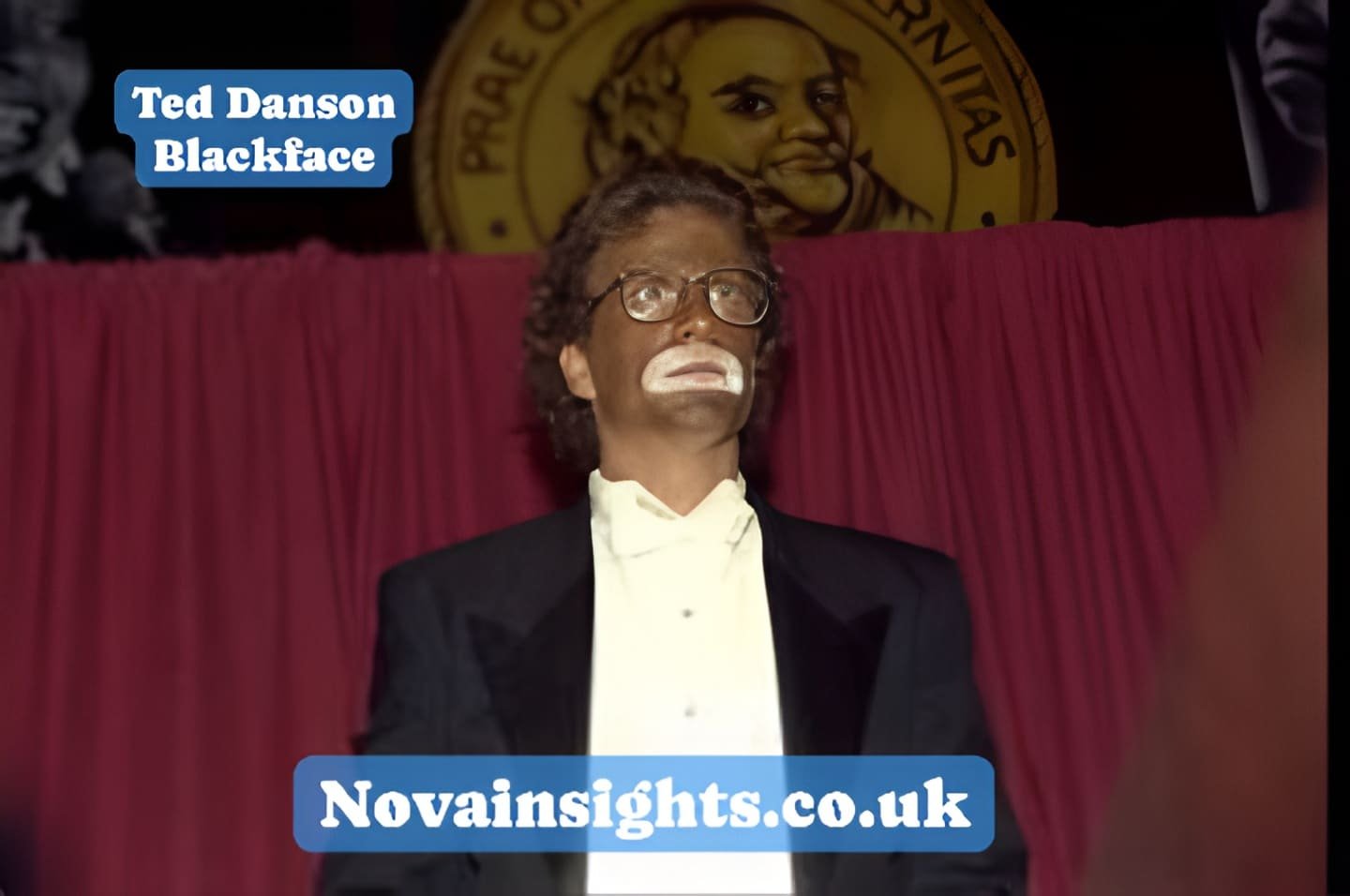
In October 1993, actor Ted Danson appeared in blackface at a Friars Club roast honoring his then-girlfriend Whoopi Goldberg in New York. He used highly offensive racial slurs repeatedly, made vulgar jokes, and even ate watermelon on stage. The performance shocked over 3,000 attendees, triggered a national debate on race and comedy, and nearly destroyed Danson’s career overnight.
On October 8, 1993, Ted Danson — one of America’s most beloved TV stars thanks to his role in Cheers — walked onto a stage at the New York Hilton Hotel wearing blackface makeup, a top hat, and white-painted lips. He was the roastmaster at the Friars Club roast honoring Whoopi Goldberg, his girlfriend at the time. The act included racial slurs used over a dozen times, jokes about their sex life, and stereotypical props. While Goldberg herself defended the performance — even claiming she helped write it — the incident triggered massive public backlash, caused Montel Williams to resign from the Friars Club, and sent shockwaves through Hollywood. Danson later reflected on the moment as a deeply graceless chapter in his life. The incident remains one of the most discussed celebrity controversies involving race and the limits of comedy.
Quick Bio Table — Ted Danson
| Detail | Information |
| Full Name | Edward Bridge Danson III |
| Date of Birth | December 29, 1947 |
| Place of Birth | San Diego, California, USA |
| Nationality | American |
| Profession | Actor, Producer, Environmental Activist |
| Famous For | Cheers (Sam Malone), The Good Place (Michael) |
| Education | Carnegie Mellon University (BFA in Drama, 1972) |
| Spouse | Mary Steenburgen (m. 1995–present) |
| Net Worth | Approximately $80 million |
| Notable Awards | 2 Emmy Awards, 3 Golden Globe Awards |
| Incident | Ted Danson blackface performance — Friars Club Roast, October 8, 1993 |
Introducing Who Is Ted Danson?
Edward Bridge Danson III — known to the world simply as Ted Danson — is one of America’s most iconic television actors, best remembered for his decade-spanning role as Sam Malone on the beloved NBC sitcom Cheers. Born on December 29, 1947, in San Diego, California, Danson grew up in Flagstaff, Arizona, where his father served as an archaeologist and museum director. From a young age, he was drawn to performance, eventually earning a Bachelor of Fine Arts in drama from Carnegie Mellon University in 1972. His path to Hollywood was gradual, built on guest appearances and small roles before his defining 1982 casting on Cheers turned him into a genuine superstar.
The 1993 Friars Club Roast That Shocked the Nation
The Friars Club, one of America’s oldest celebrity social organizations, has long hosted comedy roasts where outrageous jokes and over-the-top humor are the norm. On October 8, 1993, the club organized a roast to honor actress and comedian Whoopi Goldberg. It was a star-studded evening attended by over 3,000 guests at the New York Hilton Hotel, with tickets priced at $250 each as a charity benefit. What no one fully anticipated was that the roastmaster — Ted Danson, Goldberg’s boyfriend at the time — would arrive on stage in full blackface makeup, complete with exaggerated white-painted lips, a top hat, and a tuxedo reminiscent of old-fashioned minstrel show performers.
What Exactly Happened That Night
Ted Danson’s entrance in blackface stopped the ballroom cold. Audience members, many of whom were prominent celebrities and public figures including Halle Berry, Vanessa Williams, RuPaul, and New York Mayor David Dinkins, watched in stunned disbelief as Danson launched into a monologue filled with the N-word used repeatedly — reportedly more than a dozen times — along with extremely graphic jokes about his intimate relationship with Goldberg. At one point during the performance, he ate from a tray of watermelon, one of the most loaded racial stereotypes in American history. The laughter in the room grew thinner and more uncomfortable with each passing minute, as even those who had come expecting boundary-pushing humor found themselves wincing.
The Audience Reaction and Walkouts
Not everyone sat quietly through the performance. Montel Williams, the prominent Black talk show host who was seated at the dais, walked out just seven minutes into Danson’s set and immediately announced his resignation from the Friars Club via telegram. In his message, Williams wrote that he was unsure whether he was at a Friars event or at a rally for extremist hate groups. He added that when Danson made jokes about mixed-race children, his own white wife — who had recently given birth to their child — began crying visibly. Several other attendees also quietly removed themselves from the ballroom, signaling that the boundary between provocative humor and genuine racial offense had been crossed.
Also read this: Emily Ruth Black: The Untold Story of RFK Jr.’s Remarkable First Wife
Whoopi Goldberg’s Surprising Defense
Despite the room’s discomfort, Whoopi Goldberg sat beside Danson laughing and smiling throughout the performance. Speaking last at the event, she boldly defended him, stating that it took real courage to appear in blackface before thousands of people and that she personally found the act funny and meaningful. The next day she held a press conference reiterating her stance, revealing that she had herself helped write much of Danson’s material. She framed the routine as a satirical response to the enormous volume of racist hate mail the interracial couple had received from the public. Goldberg’s defense was itself controversial — many argued that a Black woman’s co-authorship did not neutralize the harm caused to the broader audience and public.
The Fallout — A National Conversation on Race and Comedy
The morning after the roast, newspaper headlines across the country lit up with the story. The controversy was so significant that, as Whoopi Goldberg herself wryly noted, it pushed the ongoing crisis in Somalia off the front pages of major New York newspapers. The Friars Club initially issued a formal apology to anyone offended by the racial content. Then, in a strange reversal, the all-male organization withdrew its apology just days later, claiming that critics had misunderstood the private club’s longstanding tradition of transgressive humor. The back-and-forth made the situation even messier and kept the story alive in media cycles for weeks.
Media Coverage and Public Opinion
Television shows, op-ed columns, and think pieces proliferated rapidly in the days following the roast. Bill Maher — then hosting a new Comedy Central show — publicly defended Danson, arguing that the entire point of a Friars roast was to go over the line. Critics of all backgrounds pushed back hard, noting that the painful historical weight of blackface in America — rooted in minstrelsy, dehumanization, and systemic racism — cannot simply be laundered through the permission of a roast format. Roger Ebert, the legendary film critic who was present that evening, filed a contemporaneous report noting how the laughter died progressively, a telling signal that even a room conditioned to accept outrageous humor had hit its limit.
Ted Danson’s Response and Personal Reflection
Ted Danson himself remained largely quiet in the immediate aftermath, letting Goldberg take the lead in public commentary. A statement issued in his name expressed that he had not intended to come across as racist. The couple broke up less than a month after the roast — though both parties have consistently stated the split was unrelated to the incident. Years later, in a 2009 interview on NPR’s Fresh Air, Danson addressed the moment with unusual candor, calling it a graceless moment in his life and expressing regret for the pain it caused. His willingness to sit with the discomfort of the memory, rather than aggressively defend it, became part of how the public eventually reconciled the incident with his otherwise well-regarded personal reputation.
Ted Danson the Man — Career, Legacy, and Redemption
Beyond the 1993 controversy, Ted Danson’s professional life is a story of remarkable longevity and reinvention. His career as Sam Malone on Cheers ran for eleven seasons from 1982 to 1993 and earned him two Primetime Emmy Awards and two Golden Globe Awards. At the height of the show’s popularity, he was the highest-paid actor on American television, earning $450,000 per episode — roughly equivalent to $25 million per season in today’s money. The show’s finale in May 1993 was watched by 80 million viewers, making it the second most-watched series finale in television history at the time. His career following Cheers demonstrated genuine versatility, from the sitcom Becker to the drama Damages to an acclaimed late-career renaissance on The Good Place.
His Relationship With Whoopi Goldberg
Ted Danson and Whoopi Goldberg’s relationship was one of the most publicly dissected celebrity romances of the early 1990s, largely because it was an interracial pairing at a time when such relationships still attracted hostility and public scrutiny. The two began dating while Danson was still legally married to Cassandra Coates, which added another layer of controversy to their public image. Goldberg has spoken about the enormous amount of hate mail the couple received, some of it explicitly racist. It was this environment of hostility, she later explained, that motivated the concept behind Danson’s roast monologue — an attempt to satirize the racial anxieties that surrounded their relationship. The couple parted ways in October 1993, shortly after the roast dominated headlines nationwide.
Environmental Activism and Later Career
Away from the cameras, Ted Danson has built a second identity as a dedicated environmental activist focused particularly on ocean conservation. He is a co-founder and board member of Oceana, one of the world’s largest ocean advocacy organizations. His commitment to ocean health has been a consistent thread running through his public life for several decades. In his later career, Danson continued earning both critical and commercial acclaim. His portrayal of Michael — an immortal demon architect of the afterlife — on NBC’s The Good Place introduced him to an entirely new generation of fans and earned him another Emmy nomination. In 2024, he starred in the Netflix comedy A Man on the Inside, and in 2025, he received the prestigious Carol Burnett Award for lifetime achievement in television.
Conclusion
The Ted Danson blackface incident of 1993 remains one of the most debated moments in celebrity history — a collision of comedy, race, satire, and privilege that continues to provoke genuine disagreement decades later. Understanding it fully requires holding multiple truths at once: that Whoopi Goldberg co-authored the material and defended it as satire; that the broader public and many attendees found it deeply harmful; that Ted Danson himself eventually acknowledged it as a low point; and that the event sparked a national conversation about what comedy is allowed to do and who bears the cost. Danson went on to rehabilitate his image through talent, humility, and decades of meaningful work — but the 1993 roast will remain permanently attached to his legacy as a reminder that even well-intentioned choices can cause real harm when filtered through the painful lens of racial history.
Frequently Asked Questions (FAQs)
Q1: When did the Ted Danson blackface incident happen?
A: It occurred on October 8, 1993, at a Friars Club roast honoring Whoopi Goldberg at the New York Hilton Hotel.
Q2: Why did Ted Danson wear blackface at the roast?
A: According to Whoopi Goldberg, she and Danson co-wrote the material as a satirical response to racist hate mail they had received as an interracial couple. Danson claimed “she dared me to do this.”
Q3: Did Whoopi Goldberg defend Ted Danson?
A: Yes. Goldberg strongly defended Danson, held a press conference the next day supporting him, and revealed that she had helped write most of his routine.
Q4: Who walked out of the roast in protest?
A: Montel Williams, the Black talk show host, walked out seven minutes into Danson’s set and resigned from the Friars Club, comparing the atmosphere to a KKK rally.
Q5: Did Ted Danson apologize for the blackface performance?
A: In a 2009 Fresh Air interview, Danson called it “a graceless moment in my life,” indicating deep personal regret for how the incident unfolded.
Q6: Did the incident affect Ted Danson’s career permanently?
A: The controversy was damaging but not career-ending. Danson rebuilt his reputation through continued acclaimed work in Becker, The Good Place, CSI, and most recently A Man on the Inside.
Q7: What is the historical significance of blackface in America?
A: Blackface originates from 19th-century minstrel shows where white performers darkened their faces to mock and dehumanize Black Americans. It is widely recognized as a symbol of systemic racism and cultural degradation, which is why Danson’s use of it caused such profound outrage regardless of comedic intent.
Fore more info: Novainsights.co.uk
