
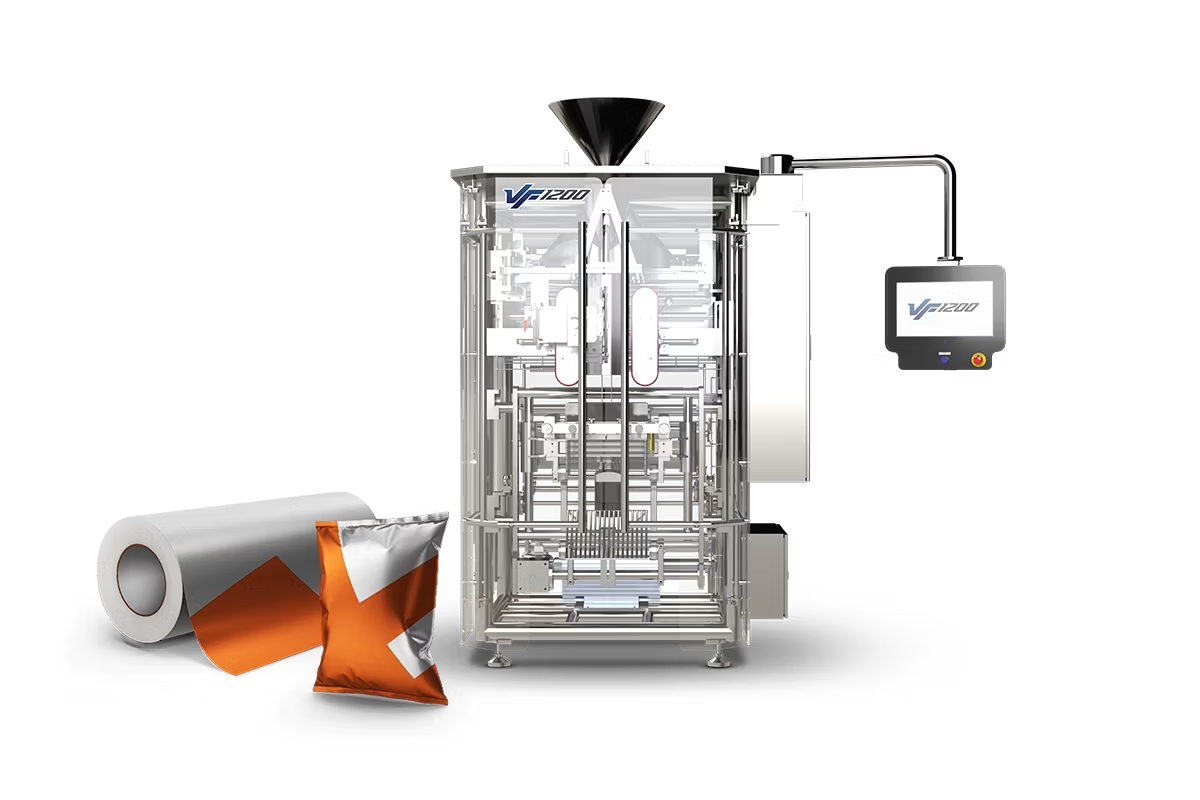
In today’s competitive manufacturing environment, packaging has become one of the most important parts of the production process. Businesses are no longer focused only on creating products, but also on how efficiently and safely those products are packaged for global distribution. Rising demand, faster supply chains, and strict hygiene standards have pushed industries toward automation. In this transformation, the vertical form fill seal machine has emerged as a key technology driving efficiency, consistency, and scalability across multiple sectors.
A vertical form fill seal machine is an advanced automated packaging system that forms a pouch from a roll of film, fills it with product, and seals it in a continuous vertical process. This eliminates the need for multiple manual steps and allows industries to achieve high-speed production with consistent quality.
From food manufacturing to pharmaceuticals and consumer goods, this technology is now widely used because of its ability to simplify packaging operations while improving performance.
Understanding the Vertical Form Fill Seal Machine
A vertical form fill seal machine is designed to automatically create packaging bags or pouches from flat roll film. It forms the package vertically, fills it with a measured quantity of product, and then seals it securely in one continuous cycle.
This system is widely used for both dry and liquid products depending on machine configuration. It supports a variety of packaging styles, making it suitable for different industries.
The integration of forming, filling, and sealing into one automated system reduces human involvement and increases production efficiency significantly.
How Vertical Form Fill Seal Machine Works
The working process of a vertical form fill seal machine is based on continuous automation.
First, a roll of packaging film is loaded into the system. The film is pulled downward and shaped into a tube using a forming collar. A vertical seal is created along the edge to form a pouch.
Next, the bottom of the pouch is sealed, and the product is accurately measured and filled into it. After filling, the top is sealed, and the finished package is cut and separated from the film roll.
This process repeats continuously, allowing the machine to produce a large number of packages in a short time with high accuracy.
Why Vertical Form Fill Seal Machine Is Becoming Essential in Modern Industry
The growing demand for the vertical form fill seal machine is driven by industrial expansion and the need for faster production systems.
One of the main reasons is efficiency. Traditional packaging involves multiple manual steps, which slow down production and increase labor costs. VFFS machines solve this problem by combining all steps into one automated process.
Another major factor is hygiene. In industries like food and pharmaceuticals, minimizing human contact is essential to maintain safety and meet strict regulatory standards.
Additionally, businesses today require scalable systems that can handle large production volumes without compromising consistency or quality.
Key Benefits of Vertical Form Fill Seal Machine
High-Speed Production Capability
A vertical form fill seal machine can produce hundreds to thousands of packaged units per hour, making it ideal for large-scale manufacturing operations.
Improved Hygiene and Safety
Since the process is fully automated, human contact is reduced, ensuring better hygiene and lower contamination risk.
Cost Efficiency
Automation reduces labor requirements and material waste, helping companies lower overall production costs.
Consistent Packaging Quality
Every package is formed, filled, and sealed with precision, ensuring uniform size, weight, and appearance across all units.
Applications of Vertical Form Fill Seal Machine
The vertical form fill seal machine is widely used across multiple industries due to its flexibility and reliability.
In the food industry, it is used for packaging snacks, rice, flour, sugar, coffee, and frozen foods while preserving freshness.
In pharmaceuticals, it is used for hygienic packaging of powders, tablets, and medical products.
In agriculture, it is used for seeds, fertilizers, and animal feed packaging.
It is also widely used in chemical and consumer goods industries for powders, detergents, and liquid-based products.
Types of Vertical Form Fill Seal Machine Systems
Different types of VFFS systems are available depending on production needs.
Standard machines are used for general packaging applications. Multi-head weigher systems are used for fast and accurate weight-based packaging. Auger filler systems are ideal for powder products, while liquid filling systems are designed for fluid packaging.
Each vertical form fill seal machine type is selected based on product nature and production requirements.
How Vertical Form Fill Seal Machine Improves Industrial Efficiency
Modern manufacturing depends heavily on automation, and VFFS machines play a critical role in improving efficiency.
By combining forming, filling, and sealing into a single process, they eliminate production delays and reduce operational complexity.
This leads to faster output, improved workflow management, and reduced human errors, allowing industries to maintain high productivity levels.
Future of Vertical Form Fill Seal Machine Technology
The future of packaging automation is closely linked with robotics, artificial intelligence, and smart factory systems.
Modern vertical form fill seal machine technology is becoming more advanced with features such as automated calibration, real-time monitoring, and predictive maintenance.
With Industry 4.0 integration, these machines are becoming part of connected production systems that optimize performance and reduce downtime.
As global demand continues to grow, VFFS technology will remain a central part of industrial automation worldwide.
Final Thoughts
The evolution of packaging systems has completely changed how industries operate, and automation has become essential for growth and efficiency. In this transformation, the vertical form fill seal machine stands out as one of the most powerful innovations in modern industrial packaging.
Its ability to integrate forming, filling, and sealing into one continuous automated process makes it highly efficient, reliable, and cost-effective for large-scale production. Industries such as food processing, pharmaceuticals, agriculture, and chemicals rely heavily on this technology to meet increasing global demand.
As technology continues to advance, vertical form fill seal machines will become even more intelligent and integrated into smart manufacturing environments, shaping the future of global packaging automation systems.
