
Artificial intelligence (AI) and high-performance computing (HPC) are transforming the way organizations process data, train machine learning models, and perform complex scientific calculations. As AI models continue to grow in size and complexity, the underlying network infrastructure must evolve to handle unprecedented volumes of data traffic while maintaining low latency and high reliability. In modern AI and HPC environments, network connectivity has become just as important as computing power itself.
To meet these growing demands, data center operators are increasingly adopting 400G networking technologies. High-bandwidth optical interconnects enable faster communication between GPUs, CPUs, storage systems, and network switches, reducing bottlenecks that can slow down distributed computing workloads. Among the available solutions, silicon photonics-based optical transceivers are gaining significant attention due to their ability to deliver high performance, power efficiency, and scalability.
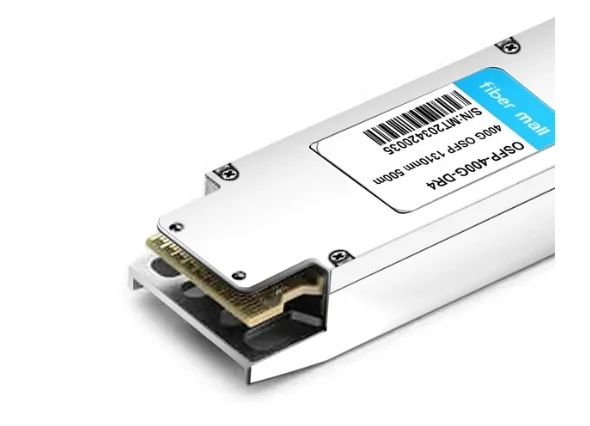
As a result, 400G OSFP modules have become an important component in next-generation AI clusters and HPC networks. In particular, 400GBASE-DR4 SiPh OSFP optical transceivers provide a compelling combination of high bandwidth, efficient thermal management, and cost-effective optical connectivity, making them well-suited for large-scale computing environments.
The Growing Network Demands of AI and HPC Clusters
AI training workloads often involve thousands of GPUs working together to process massive datasets and train large language models. During this process, enormous amounts of data must be exchanged between computing nodes. Similarly, HPC applications such as weather forecasting, molecular simulations, financial modeling, and scientific research require continuous communication between servers to perform parallel computations efficiently. As the scale of these systems increases, traditional network architectures can struggle to keep up with bandwidth requirements.
Network congestion can significantly reduce the efficiency of AI and HPC systems. Even the most advanced processors can become underutilized if data cannot move quickly enough between nodes. This challenge has driven the adoption of 400G Ethernet and InfiniBand technologies, which provide the bandwidth necessary to support modern distributed computing workloads while minimizing latency and maximizing resource utilization.
Understanding 400GBASE-DR4 SiPh OSFP Modules
What Is 400GBASE-DR4?
400GBASE-DR4 is a high-speed optical transmission standard designed for short- to medium-reach single-mode fiber connections. It achieves an aggregate bandwidth of 400Gbps by utilizing four parallel optical lanes, each operating at 100Gbps PAM4 modulation. The standard typically supports transmission distances of up to 500 meters over single-mode fiber, making it ideal for data center interconnections and intra-cluster networking.
The DR4 architecture uses an MPO-12/APC connector and transmits data over four pairs of optical fibers. This parallel optics approach enables efficient high-speed communication while maintaining relatively simple optical designs compared to longer-reach technologies.
The Advantages of Silicon Photonics Technology
Silicon photonics, often abbreviated as SiPh, integrates optical components onto silicon-based chips using semiconductor manufacturing processes similar to those used in the electronics industry. This approach allows optical engines to be produced with greater precision and scalability than many traditional optical technologies.
For AI and HPC deployments, silicon photonics offers several important benefits. It enables lower power consumption, supports high-density port configurations, and improves manufacturing consistency. As network speeds continue to increase, these advantages become increasingly valuable because power efficiency and scalability directly affect data center operating costs and deployment flexibility.
Why OSFP Is Ideal for AI Infrastructure
Superior Thermal Performance
One of the most important considerations in AI clusters is thermal management. High-performance GPUs generate significant amounts of heat, and network equipment must operate reliably in these demanding environments. The OSFP form factor was specifically designed with enhanced thermal capabilities, allowing it to support high-power optical modules more effectively than some earlier transceiver formats.
The closed finned-top heat sink design commonly found in OSFP modules helps improve heat dissipation and maintain stable operating temperatures. This thermal efficiency is particularly important in AI clusters where thousands of high-speed optical links may be deployed simultaneously within a single facility.
High-Density Connectivity
AI and HPC networks often require large numbers of interconnected servers and switches. The compact design of OSFP modules enables network operators to deploy high port densities while maintaining manageable power and cooling requirements. This allows data centers to scale their infrastructure without significantly increasing rack space consumption.
As AI clusters expand from hundreds to thousands of computing nodes, high-density optical connectivity becomes essential for maintaining efficient network architectures and supporting future growth.
Supporting Spine-Leaf Architectures in AI Data Centers
Enabling High-Bandwidth East-West Traffic
Most modern AI data centers utilize spine-leaf network architectures to provide predictable performance and scalable connectivity. In these environments, the majority of network traffic flows horizontally between servers rather than vertically to external networks. This pattern, often referred to as east-west traffic, requires substantial bandwidth throughout the data center fabric.
400GBASE-DR4 SiPh OSFP modules provide the high-speed optical links necessary to support this traffic flow. Their 400Gbps bandwidth helps ensure that data can move rapidly between compute nodes, reducing communication delays and improving overall workload efficiency.
Supporting Scalable Cluster Expansion
AI infrastructure continues to grow rapidly as organizations deploy larger models and more advanced applications. Network solutions must therefore be capable of scaling without requiring major architectural changes. Because 400GBASE-DR4 modules support standardized high-speed connectivity over single-mode fiber, they allow operators to expand clusters efficiently while maintaining consistent network performance.
This scalability is particularly valuable in hyperscale data centers and research institutions where infrastructure upgrades must support future technology generations without excessive complexity.
Improving Power Efficiency and Operational Costs
Power consumption has become a critical concern for data center operators. AI training clusters can consume enormous amounts of energy, making efficiency improvements highly desirable. Silicon photonics technology helps address this challenge by reducing the power required for optical signal generation and transmission.
By combining silicon photonics with the thermally optimized OSFP form factor, 400GBASE-DR4 modules contribute to lower overall network power consumption. Reduced energy usage not only decreases operational expenses but also supports sustainability initiatives aimed at improving data center efficiency and reducing environmental impact.
Conclusion
As AI and HPC workloads continue to push the limits of computing infrastructure, high-performance networking solutions are becoming increasingly important. 400GBASE-DR4 SiPh OSFP optical transceivers deliver the bandwidth, scalability, thermal efficiency, and power savings needed to support modern computing environments.
By enabling fast and reliable communication between servers, switches, and accelerators, these modules play a vital role in AI training clusters, HPC systems, and next-generation data centers. As the industry moves toward even higher network speeds, silicon photonics-based 400G connectivity will remain a key technology for building efficient and scalable computing infrastructures.
