
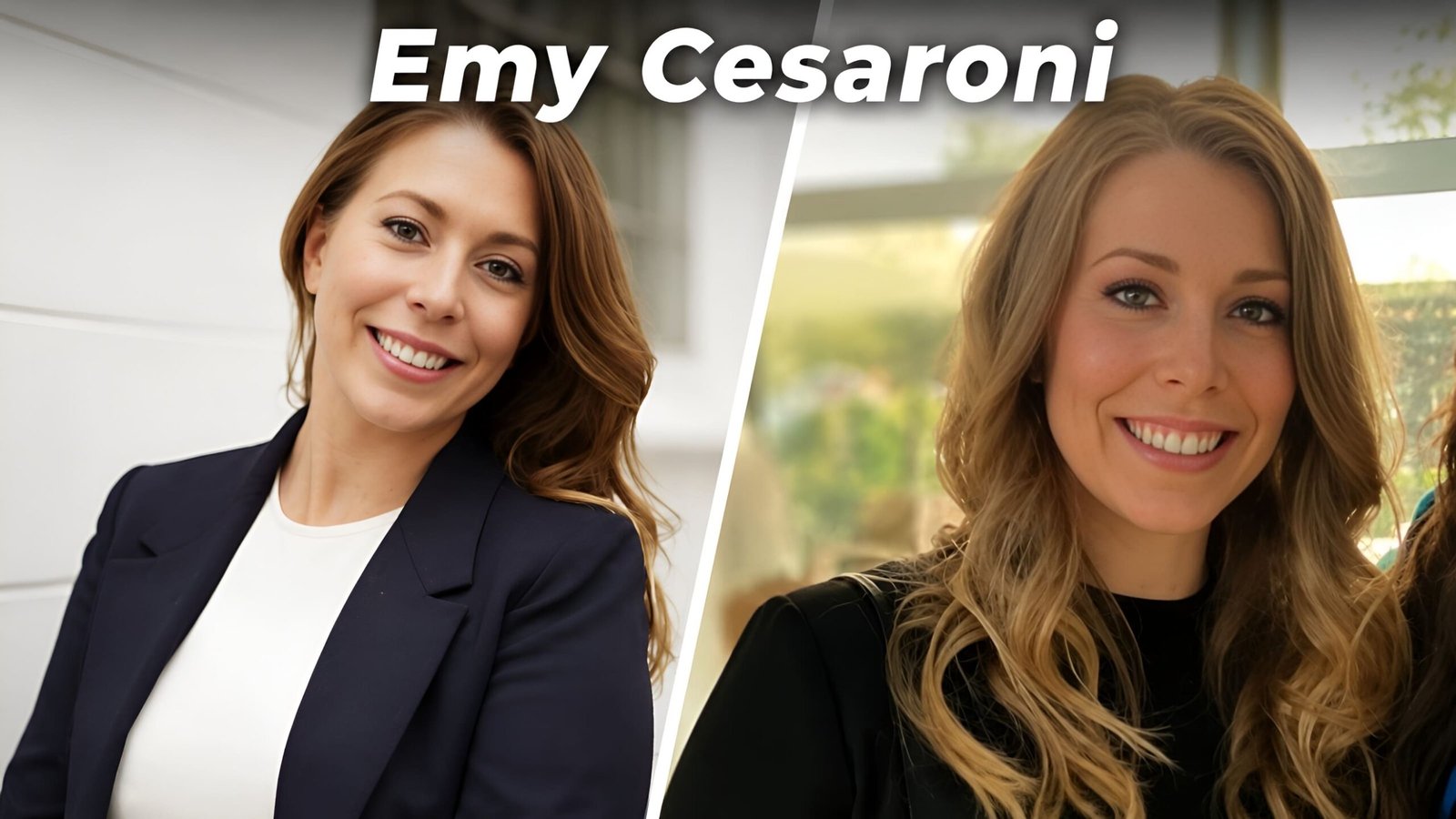
Emy Cesaroni (born 15 April 1952, Terni, Italy) is a celebrated Italian singer and actress who rose to fame under the Style record label in the late 1960s and 1970s. She debuted at the “Fuori la voce” festival in Alassio in 1968, later recorded in Germany under the stage name “Sabrina,” and is also known as the mother of Italian-American film producer Tharita Cesaroni.
Quick Bio Table
| Detail | Information |
| Full Name | Emi Cesaroni |
| Stage Name | Emy Cesaroni / Sabrina (Germany) |
| Date of Birth | 15 April 1952 |
| Place of Birth | Terni, Italy |
| Nationality | Italian |
| Profession | Singer, Actress |
| Record Label | Style (Italy), Polydor (Germany) |
| Active Years | 1968 – late 1970s |
| Spouse | Franco Catullé (married 20 July 1972) |
| Children | Tharita Cesaroni (film producer) |
| Known For | “Sette giorni,” Settevoci theme, Sanremo Festival, ZDF Hitparade |
Who Is Emy Cesaroni?
Emy Cesaroni is an Italian singer and actress born on 15 April 1952 in Terni, central Italy. She emerged on the national music scene in 1968 and became a recognized voice in Italian pop and light music (musica leggera) throughout the 1970s. Signed to the Style record label, she performed at major festivals and appeared on national television, building a loyal fanbase across Italy. She is also recognized internationally as the mother of Tharita Cesaroni, the Italian-American cinematographer and film producer married to Hollywood actor Dermot Mulroney.
Her story combines artistic talent, legal courage, and cross-cultural ambition — a performer who navigated Italian entertainment, fought an unjust industry decision, and reinvented herself entirely in the German-speaking music world.
Early Life and Roots in Terni, Italy
Emy Cesaroni grew up in Terni, a historic industrial city in the Umbria region of central Italy. Her formative years coincided with Italy’s post-war economic boom — the “miracolo economico” — a period that brought fresh energy to the arts, film, and music across the country. This cultural awakening shaped her early artistic instincts and sparked her passion for performance.
Though Terni was far from entertainment hubs like Rome or Milan, it gave her a grounded authenticity that set her apart. She developed her vocal talent steadily during her teenage years, building the stage confidence and musical discipline that would carry her through a decade-long professional career in one of Europe’s most competitive music industries.
The 1968 Debut at “Fuori la Voce” Festival in Alassio
The year 1968 marked Emy Cesaroni’s formal entry into the Italian music world. She performed at the “Fuori la voce” festival in the coastal town of Alassio — a respected competition for emerging talent. Although first prize went to Ada Mori, she earned a special trophy for her song “Il giorno,” a result that drew immediate attention from record industry professionals in the audience.
Her Alassio performance was the catalyst for signing with the Style label, which brought her professional production support and national distribution. This single appearance transformed her from a regional talent into a contender on the Italian pop stage, opening doors to television, major festivals, and a career that would span the 1970s and stretch across European borders.
“Sette Giorni” — The National Television Theme That Made Her Famous
In 1969, her career reached a landmark moment with “Sette giorni,” written by Pippo Baudo, Sergio Paolini, and Stelio Silvestri, with music by Riccardo Vantellini and Pippo Baudo. The song was selected as the official opening theme for the beloved Italian variety television program “Settevoci” during its 1969–1970 season — one of the highest-profile placements any Italian pop song could achieve at the time.
For an artist still in the early stages of her career, having a theme song broadcast weekly into millions of Italian households was transformative. It gave her name instant recognition across the country and positioned her firmly within the mainstream of Italian popular entertainment, alongside far more established artists of the era.
Venice International Light Music Exhibition — “Uragano”
Following the success of “Sette giorni,” she participated in the prestigious Mostra Internazionale di Musica Leggera di Venezia, performing “Uragano,” a song with lyrics and music by Cesare Bovio. The Venice showcase was one of Italy’s most culturally significant music events, dedicated to celebrating the finest in Italian songwriting and vocal performance.
Being selected for Venice confirmed that she was not simply a television novelty but a serious, versatile artist. The event placed her alongside Italy’s top musical talent and reinforced her reputation as a performer with genuine range — equally comfortable on the television screen and the concert stage.
The 1971 International Tour to Bulgaria
In 1971, her reach extended beyond Italy when she joined fellow artists Paola Battista and Brunetta on an international performance tour to Bulgaria. Cultural exchange tours to Eastern European countries were a meaningful part of Italy’s soft diplomacy during the Cold War era, and being chosen to represent Italian entertainment abroad was a mark of professional standing.
Performing in Bulgaria required adaptability — reaching audiences with different cultural references and musical expectations. This experience proved valuable preparation for what would come later in her career: recording entirely in a foreign language and competing in the German pop market as a fully reinvented artist.
Marriage, Family, and Life in Milan
On 20 July 1972, she married Franco Catullé, an entertainment impresario from Catanzaro in Calabria, in a ceremony held in Milan. Their wedding was attended by prominent industry figures including record producer Ardo Deveras and impresario Nando Dagradi — a reflection of the couple’s standing in Italian show business. The following year, in 1973, their daughter Tharita Cesaroni Catullé was born in Milan.
Milan provided the perfect base for a working artist with family responsibilities. The city’s deep connections to fashion, design, television, and music meant that professional opportunities were always close at hand. Importantly, the creative household Emy built there would later shape Tharita’s own path — not as a performer, but as an award-calibre cinematographer and film producer in both Italy and Hollywood.
The 1975 Sanremo Controversy and Six-Year Legal Battle
Competing at the Festival di Sanremo — Italy’s most prestigious music competition — in 1975 should have been a career high point. Instead, her entry “1975… amore mio” was controversially excluded on plagiarism allegations, a damaging and public blow. Rather than accepting the decision, she pursued legal action against the festival organizers.
The case took six years to resolve. In 1981, the court ruled fully in her favor, declaring the song’s publication valid and ordering the Municipality of Sanremo to pay a fine of 10 million lire. The outcome was a significant personal and legal vindication — proving not only her artistic integrity but also her willingness to fight institutional injustice, a quality that defined her character throughout her career.
Reinvention in Germany as “Sabrina” — The Peter Thomas Connection
In 1975, while at Saint-Tropez, she encountered German composer and orchestra conductor Peter Thomas — a prolific figure known across Europe for his film and television scores. Thomas offered her a German-language audition for the Polydor label in Hamburg. She accepted, adopted the stage name “Sabrina,” and began an entirely new chapter of her career in the German-speaking music market.
This transition required her to record in a language she was not raised in and compete in a market with different tastes and commercial dynamics. Rather than translating her Italian identity directly, she built a fresh persona as Sabrina — demonstrating that her talent was not limited by geography or language, but could adapt and resonate across cultures.
“Ohne dich ist es Nacht” and the Global Reach of Inspector Derrick
Her most internationally significant recording came with the 1976 single “Ohne dich ist es Nacht” (Without You It Is Night), written by Peter Thomas. The song was used as the central theme for Episode 17 — “Tod des Trompeters” (Death of a Trumpeter) — of the iconic German crime drama “Derrick,” with actress Sabine von Maydell lip-syncing to her vocals on screen. The B-side, “Opium,” was an instrumental also composed by Thomas for the same episode.
“Derrick” (Inspector Derrick) was broadcast in over 100 countries, making it one of the most globally distributed German television series in history. Her voice, as Sabrina, therefore reached audiences far beyond Germany — across Europe, Latin America, and beyond — giving her an international exposure that few Italian artists of her generation could claim.
ZDF Hitparade Appearance and German Pop Recognition
On 16 April 1977, she appeared as Sabrina on the 92nd edition of the ZDF Hitparade — Germany’s premier music chart television program on public broadcaster ZDF. She performed “…und du willst gehn,” the German-language adaptation of the internationally celebrated Spanish hit “Porque te vas,” originally performed by Jeanette. The same song was also covered in German by Nina Lizell, illustrating how competitive the market was.
The ZDF Hitparade reached mass audiences across Germany, Austria, and Switzerland every week. A featured performance slot was not given to unknown acts — it was reserved for artists with genuine commercial presence. Her appearance there confirmed that her Sabrina persona had successfully broken into the mainstream German pop world, earning her a place among recognized names in European popular music.
Dual Identity: Emy Cesaroni in Italy, Sabrina in Germany
One of the most distinctive and underappreciated aspects of her career was her ability to operate under two completely separate artistic identities simultaneously — Emy Cesaroni for Italian audiences and Sabrina for German-speaking markets. Rather than attempting to carry her Italian brand directly into Germany, she made a deliberate creative decision to adapt her identity to suit each market’s cultural expectations.
This strategic flexibility — linguistic, stylistic, and commercial — was rare among Italian performers of her era. It reflects a level of professionalism and self-awareness that goes beyond simply being a good singer. She was, in effect, a bilingual artist who understood branding before the term was widely used in the music industry, making her an underappreciated pioneer of the pan-European pop movement.
Legacy, Discography, and Where to Listen
Her recorded output spans both Italian and German releases. Italian highlights include “Il giorno,” “Sette giorni,” “Uragano,” “Folle amore,” and “Pazzo, pazzo cuore.” Her German catalog as Sabrina includes “Ohne dich ist es Nacht,” “Opium” (instrumental), and “…und du willst gehn,” all produced by Peter Thomas for Polydor. Her music is available on Apple Music, and European archives hold additional recordings from both phases of her career.
Her legacy rests on four pillars: a nationally broadcast TV theme that reached millions of Italian households; a hard-fought legal victory that set a precedent at Sanremo; a pioneering cross-cultural music career spanning two countries and two languages; and the creative household she built in Milan that nurtured Tharita Cesaroni into one of Italy’s most respected film professionals.
Conclusion
Emy Cesaroni’s career is a study in artistic resilience and reinvention. From her 1968 festival debut in Alassio to the national television exposure of “Sette giorni,” from the Venice stage to a Bulgarian tour, from the Sanremo courtroom to the ZDF Hitparade in Germany — each chapter added a new dimension to her story. She never chased fame passively; she built it deliberately, defended it legally, and expanded it internationally. Her legacy belongs not just in footnotes about her daughter’s Hollywood connection, but at the center of any serious discussion of Italian popular music in the 1960s and 1970s.
Frequently Asked Questions (FAQs)
Who is Emy Cesaroni?
An Italian singer and actress born 15 April 1952 in Terni, active in the Italian and German music scenes during the 1960s–70s. She recorded under the Style label in Italy and as “Sabrina” for Polydor in Germany.
What is her most famous song?
“Sette giorni” (1969), co-written by Pippo Baudo, served as the theme for Italian TV show “Settevoci” in 1969–70 — her most widely recognized Italian recording.
Why did she use the name “Sabrina” in Germany?
After meeting composer Peter Thomas in 1975, she adopted “Sabrina” as a stage name for the German market to build a culturally appropriate identity separate from her Italian persona.
What happened at the 1975 Sanremo Festival?
Her entry “1975… amore mio” was wrongly disqualified on plagiarism grounds. She fought a legal battle that lasted until 1981, when a court vindicated her and fined the festival organizers 10 million lire.
